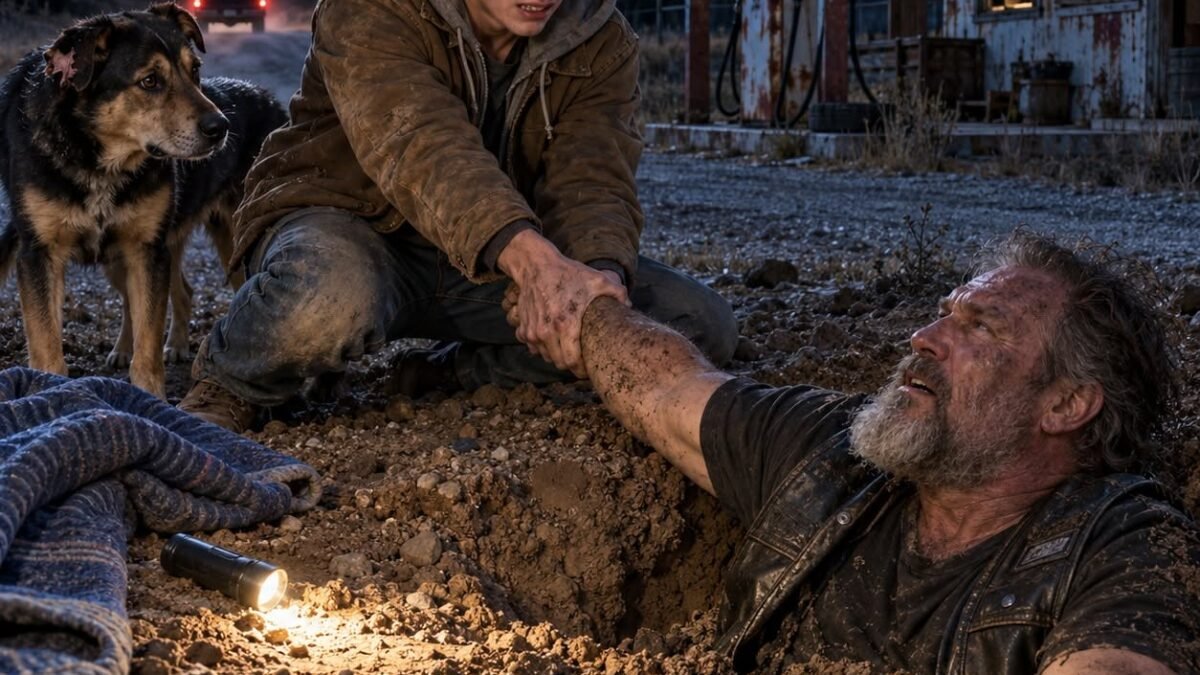
The man’s hand was still moving when they started covering his face.

I watched from behind a rusted gas pump, one arm wrapped around my dog, telling myself not to make a sound.
I was nineteen. Homeless. Hungry.
And I was about to let a stranger die because I was afraid.
My name is Noah Bennett. By that October, I had spent almost two years learning how to disappear.
My mother died when I was seventeen. After the funeral, I stayed with relatives until the offers became sighs, then arguments, then a suitcase beside a door.
After that came shelters, loading docks, and benches where you weren’t allowed to sleep.
I found my dog behind a grocery store outside Spokane. Someone had tied him to a shopping cart with an electrical cord.
He had a torn ear and ribs you could count from across the parking lot.
I called him Rusty.
We understood each other pretty quickly.
By the time we reached western Montana, winter was beginning to settle into the nights. I found an abandoned service station outside a town called Pine Creek and made a bed in its back office.
The roof leaked, but only in one corner.
That qualified as good housing by my standards.
Behind the station stood a broken fence and an old gravel excavation. Nobody came there.
Until that night.
I was dividing a cold can of beans between us when headlights swept across the wall.
Two trucks.
I killed my flashlight and pulled Rusty behind the old pumps.
Two men dragged a third toward the excavation.
Even stumbling, he was enormous. Broad shoulders. Heavy boots. A leather motorcycle vest.
He fought once, hard enough to send one man backward.
The other struck him with something metal.
Then they pushed him into a shallow hole.
I held Rusty’s muzzle against my jacket.
The shovels began.
I could hear the gravel landing on him.
Once, he lifted an arm.
One of the men pressed him down with a boot.
“Stay there.”
I wanted to close my eyes.
Instead, I watched until the moving hand disappeared.
When the trucks finally left, I remained crouched behind that pump, listening to their engines fade.
Every lesson the road had taught me offered the same advice.
Go inside.
Those men had money, trucks, and a willingness to do something I could barely comprehend.
I had thirteen dollars and a dog with a bad ear.
Then Rusty pulled against my arm.
He was staring toward the fresh dirt.
My mother used to say something when I got overwhelmed.
“Don’t solve your whole life tonight, baby. Just do the next right thing.”
I hated remembering it then.
Because I knew exactly where the next right thing was.
I ran.
The dirt was loose, but there was so much of it. I dropped to my knees and clawed through gravel until my fingers struck leather.
A shoulder.
I worked upward.
Found a neck.
A jaw.
His face.
“Come on,” I whispered.
I cleared his mouth as best I could.
Nothing.
Then his body jerked, and he coughed dirt against my sleeve.
I started crying so suddenly I could hardly see.
“That’s it. Stay here.”
Getting the rest of him free nearly finished me. I dug until my hands were raw, then hauled and stumbled and dragged him onto level ground.
He grabbed my jacket.
For one terrible second, I thought he would hurt me.
“I’m not them,” I said. “I pulled you out.”
His grip loosened.
I didn’t have a working phone. The nearest occupied house was miles away.
I couldn’t leave him outside.
Using an old moving blanket, I dragged him through the fence and into the station, stopping every few feet to catch my breath.
He groaned when we reached the office.
I covered him with my sleeping bag.
Sometime before dawn, his eyes opened.
“Where?”
“Old gas station. Outside Pine Creek.”
He studied the room, then looked at the dirt embedded in his clothes.
“They buried me.”
I nodded.
He stared at my hands.
“You?”
“You were moving.”
For a long time, he said nothing.
Then he asked my name.
“Noah.”
“You got somebody, Noah?”
I glanced at Rusty.
The man understood.
“People call me Bear,” he said.
I shared my water. My bread. Everything.
By afternoon, he was awake enough to find a small phone zipped inside his vest. He made one call and gave directions.
Then his expression changed.
“Those men,” he said. “They belong to my motorcycle club.”
My stomach tightened.
“They found out I knew what they were doing. They think I’m dead.”
Outside, Rusty began growling.
Headlights swept across the boarded window.
Bear struggled upright and looked through a crack.
Then he turned toward me.
“They’ve come back—and this time, they’re looking for you.”
Bear caught my sleeve before I reached the window.
“Stay low.”
Outside, an engine shut off.
Rusty’s growl deepened against my knee. I put a hand on his collar, feeling him tremble.
“How would they know about me?”
Bear pointed toward the doorway.
A muddy trail crossed the concrete. Beyond it, the moving blanket lay tangled against the broken fence.
I had been so desperate to get him inside that I hadn’t hidden anything.
A truck door slammed.
“Somebody’s been digging.”
The voice belonged to the man who had held Bear down with his boot.
I stopped breathing.
Bear reached for the phone.
One bar of service flickered on the screen.
He dialed, gave the dispatcher our location, then whispered, “Two suspects outside. Attempted homicide. One witness with me. Nineteen years old.”
He described the trucks.
Then he set the phone beneath an overturned milk crate and left the call connected.
“Help’s coming,” he told me.
“How long?”
He didn’t answer.
Footsteps crunched over gravel.
“Blanket goes through here.”
Bear looked around the office. One doorway. Boarded windows. A narrow supply closet with a broken latch.
Nowhere to run without being seen.
He tried to stand, but his knees folded.
I caught him before his head struck the desk.
That frightened me more than the voices outside. Until then, some part of me had believed that a man his size could fix this simply by getting to his feet.
He couldn’t.
He was hurt, and I was all he had.
“Listen to me,” he whispered. “You don’t owe me anything else.”
I looked at the sleeping bag beneath him.
My mother’s old blue one.
The only thing I still owned that smelled faintly familiar when the weather turned cold.
“I’m not leaving you.”
Something shifted in his face.
Then the station’s front door scraped open.
“Anybody in here?”
I knew that tone. Almost friendly. The voice adults used when they wanted you to believe you weren’t in trouble yet.
A flashlight beam passed through the outer room.
Bear squeezed my wrist once.
I pushed the office door nearly shut and stepped into the service bay.
The man stood beside the empty counter. He wore a clean canvas jacket and carried a flashlight in one hand.
His other hand stayed near his pocket.
“You alone?”
“My dog’s here.”
“What’s your name?”
“Noah.”
He looked past me.
“You been staying in this place, Noah?”
I nodded.
His eyes dropped to my hands.
The skin around my fingernails was torn. Dirt filled every crease.
His expression changed.
“Do a little digging last night?”
Behind him, the second man appeared in the doorway.
I took one step backward.
The first man smiled without warmth.
“Where is he?”
I couldn’t make my mouth work.
He caught the front of my jacket.
“Where?”
Rusty lunged between us, barking so hard the sound filled the empty station.
The man released me and stumbled back.
Then Bear spoke from the office.
“Let the kid go, Curtis.”
Both men froze.
Bear stood in the doorway, one hand braced against the frame.
Gravel still clung to his hair. My sleeping bag hung around his shoulders.
Curtis stared at him.
“You should’ve stayed down.”
Bear’s voice was barely louder than a whisper.
“You should’ve checked whether I was dead.”
The second man moved toward the front window.
I heard it then.
Engines.
More than one.
Curtis heard them too.
He backed toward the entrance, dragging his flashlight beam across the walls.
“What did you do?”
Bear didn’t answer.
White light flooded the boarded windows.
Someone outside shouted, “Sheriff’s office! Show me your hands!”
Curtis grabbed my arm.
For a second, his fingers dug so deeply I thought he would pull me in front of him.
Then another voice came from outside.
“Curtis. It’s over.”
A woman’s voice. Steady and furious.
His grip loosened.
I pulled free and fell against the counter with Rusty pressed beside me.
Everything after that seemed to happen in pieces.
Curtis facedown on the concrete.
The other man kneeling beside the truck.
A deputy asking whether anyone else was inside.
Bear sliding down the doorframe because he couldn’t hold himself upright anymore.
I crawled to him.
“Stay awake.”
His eyes found mine.
“Bossy kid.”
“Yeah. Get used to it.”
He tried to smile.
Then the paramedics came through the door.
The woman who had spoken outside was named Jo.
She rode with Bear.
So did the dozen people waiting beyond the police vehicles, their motorcycles parked along the road.
When Bear called from the office, he had reached her first. She had contacted law enforcement and told the others where he was.
They had arrived behind the deputies.
I watched them from the back of an ambulance while someone cleaned my hands.
Leather vests. Heavy boots. Faces I couldn’t read.
Two men dressed like them had put Bear in the ground.
I moved closer to Rusty.
Jo noticed.
She stopped several feet away.
“Those two don’t speak for us.”
I stared at her.
“They wore your patch.”
Her jaw tightened.
“Yes,” she said. “They did.”
She didn’t offer an excuse.
That mattered.
At the hospital, a deputy took my statement while Rusty waited outside with Jo.
I told him about the trucks, the hole, the shovels.
When I reached the part about staying behind the pump, I stopped.
“I waited.”
The deputy looked up.
“After they left. I just sat there.”
He put his pen down.
“You were scared.”
“I almost didn’t go.”
“But you did.”
I wished that made the memory easier.
It didn’t. Not right away.
Bear stayed in the hospital for six days.
He had a concussion, broken ribs, and breathing problems from what he had inhaled. For the first two days, visiting him meant watching monitors and wondering whether I had been too slow.
On the third, he was sitting up.
A paper cup of terrible coffee stood untouched beside him.
“You look worse than I do,” he said.
“I slept in a chair.”
“Bad habit.”
“You slept in a hole.”
He laughed once, then clutched his ribs.
“Don’t make me do that again.”
That afternoon, he told me why Curtis and the other man, Wade, had tried to kill him.
Bear helped manage the club’s charity fund. Money intended for injured riders and struggling families had gone missing.
At first, he thought someone had made a bookkeeping mistake.
Then he found withdrawals tied to Curtis.
Wade had helped hide them.
Bear had arranged to meet them near the service station because they claimed they could explain.
He had wanted to believe men he had known for years.
“They counted on that,” he said.
“Your friends?”
He looked toward the window.
“I thought so.”
I understood more than I wanted to.
Sometimes the people who hurt you knew exactly what you hoped they would be.
Investigators recovered the messages arranging the meeting. They found blood and disturbed soil at the excavation, along with one of the shovels in Wade’s truck.
My statement filled in what the evidence couldn’t say.
The case took months.
Bear never told me it would be easy.
When I had nightmares before an interview, he answered the phone. When I couldn’t finish telling the prosecutor what I had seen, he waited outside without asking why it took so long.
He was learning patience with his recovery.
I was learning that people could stay.
After Bear left the hospital, Jo helped me find a room through a local housing program.
I asked about Rusty before I asked about the bed.
“He comes,” she said.
I didn’t believe her until I saw his water bowl on the floor.
Bear offered me work at his repair shop once my hands healed.
“Cleaning. Stockroom. Whatever you’re comfortable learning.”
I stared at the hourly rate written on the application.
“You don’t have to pay me because I—”
“I’m paying you because it’s a job.”
He tapped the paper.
“You still have to show up.”
So I did.
At first, I arrived forty minutes early because being late felt like something that could make the room and the paycheck disappear.
I hid food in my backpack.
I kept my shoes beside the bed.
Bear noticed things without making a speech about them.
He stocked sandwich supplies in the shop refrigerator. Gave me a spare key. Asked what I wanted to learn next.
The first time I broke a customer’s mirror, I stood in his office waiting to be fired.
He looked at the damage report.
“Did you tell me right away?”
“Yes.”
“Then we’ll order another one. Come help me figure out what happened.”
I nearly cried over a motorcycle mirror.
It took me a long time to understand why.
Curtis and Wade eventually pleaded guilty.
I attended the sentencing with Bear beside me and Jo on my other side.
When the judge asked whether I wanted to speak, my knees shook so badly I stayed seated.
“I heard you tell him to stay there,” I said, looking at Curtis.
He didn’t raise his head.
“For months, I kept hearing it.”
I pressed my palms against my jeans.
“But he didn’t stay there.”
Bear’s hand settled on my shoulder.
Neither man looked at us as they were led away.
I had imagined that moment ending the nightmares.
Instead, healing came quietly afterward.
A full night’s sleep.
A savings account.
Rusty getting gray around his muzzle because he finally had the chance to grow older.
Two years later, Bear helped me move into a small apartment over the shop.
We carried the last box upstairs together.
My mother’s blue sleeping bag was folded inside it.
Bear touched the patched corner.
“I owe you a new one.”
“No.”
He looked at me.
“I’m keeping that.”
He nodded and set the box beside my bed.
That night, we ate takeout at my kitchen table. Jo brought a pie. Rusty fell asleep beneath Bear’s chair.
After they left, I stood in the quiet apartment with my hand on the light switch.
For years, darkness had meant keeping still, listening, hoping nobody found me.
Now there was a key on my counter.
Food in the refrigerator.
People downstairs who expected to see me in the morning.
I turned off the light and went to bed.
And when Rusty stirred in the night, I reached down, touched his head, and told him the words I had been waiting years to believe.