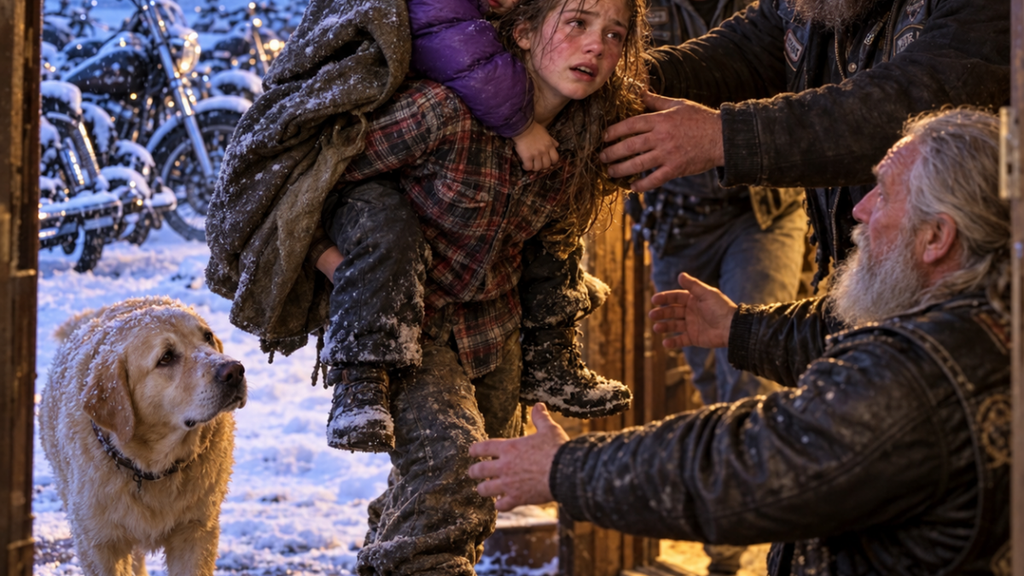
The man who opened the door looked ready to send me away.
Then he saw the little boy on my back.
Behind him, someone screamed the child’s name, and suddenly every biker in that room was running toward me.
I remember saying, “Take him first.”
After that, my legs stopped working.
My name is Hannah Mercer. I was thirteen that winter, and until that night, the most important thing in my life was making sure nobody found out where my mother and I slept.
We had a tent behind a stand of pines outside Elk Ridge, Montana.
Mom called it temporary.
She’d been calling it that for nineteen months.
Before the tent, we’d had a second-floor apartment, a kitchen window full of plants, and a dad who left his boots by the door because Mom hated finding pine needles in the carpet.
My father, Luke, was a wildland firefighter.
After he died, people brought casseroles. Then they stopped bringing them, which was reasonable. People had their own lives.
What came afterward happened slowly enough that Mom kept thinking she could stop it.
Unpaid leave. Late rent. A car repair that swallowed the money she’d saved. Then the apartment was gone, and every place we called either cost too much or had a waiting list.
She cleaned motel rooms and offices. I kept our clothes dry, collected firewood, and pretended the tent didn’t frighten me when the wind pressed its walls against my face.
We were afraid to ask for help.
Mom worried someone would decide she couldn’t take care of me. I worried they would send me somewhere she couldn’t follow.
So we became good at looking as though we belonged wherever we happened to be.
That Friday, a storm arrived before anyone expected it.
By midafternoon, snow was blowing sideways through the trees. Mom had left before dawn to clean a motel near the interstate. She’d promised to return before dark.
I was gathering the last dry kindling beneath a fallen tree when I heard a dog bark.
Three short barks.
Then nothing.
I nearly went back inside.
That is the part I still think about.
I was cold. I was hungry. I wanted to pull the sleeping bag over my head and wait for Mom.
Then the dog barked again.
I followed the sound.
He was a yellow dog with ice clinging to his whiskers, crouched beside a fallen spruce.
At first, I thought the purple shape beside him was somebody’s discarded coat.
Then I saw a boot.
The boy couldn’t have been older than five.
His eyes were open, but he didn’t turn when I spoke.
“Hey. Can you hear me?”
His mouth moved.
I knelt close enough to catch one word.
“Buddy.”
I looked at the dog.
“You found Buddy. Good job. Now we have to get you somewhere warm.”
Dad had taught me enough about cold to know the boy’s stillness was dangerous.
I wrapped my coat around him, then pulled off my sweater and tucked it over his legs. His gloves were gone. I put mine on his hands.
“What’s your name?”
It took him three tries.
“Noah.”
“Okay, Noah. I’m Hannah.”
Our tent was closer, but there was barely enough heat in it for me. I pictured the low wooden roadhouse beside the highway, its windows glowing through the trees.
The men who gathered there rode motorcycles and wore leather vests. In town, people talked about them in lowered voices.
I didn’t know whether those stories were true.
I knew they had a roof.
Getting Noah onto my back took several attempts. I used my coat sleeves to help hold him against me, then followed the fence toward the road.
Buddy stayed beside us.
I talked because Noah needed to hear something, and because silence made it too easy to think about sitting down.
I told him about my dad. About the pancakes he made shaped like animals that never looked like animals.
At first, Noah answered.
Then he stopped.
I fell once near a drainage ditch.
For a few seconds, I stayed on my knees. Resting felt sensible. Almost pleasant.
Then Noah’s cheek shifted against my neck.
I got up.
When the porch lights finally appeared, I thought they were stars.
A broad man opened the door.
“Hey, you can’t—”
He stopped.
A younger man pushed past him.
“Noah!”
I tried to loosen the coat sleeves, but my fingers wouldn’t work.
“Take him first,” I said.
Someone lifted Noah away.
An older biker caught me before my head struck the porch.
Inside, there were blankets, voices, someone calling for an ambulance.
The older man knelt beside me.
“Where are your parents, sweetheart?”
“My mom’s working.”
“Where do you live?”
I started crying.
He looked at my wet flannel shirt, then at the oversized coat wrapped around his grandson.
“You gave him this?”
I nodded.
“And you walked here without it?”
Before I could answer, the lights flickered.
Then the room went dark.
Somewhere near the bar, a radio crackled: the highway was closed.
And all I could think was that my mother was walking home to an empty tent.
“My mom,” I said, trying to push the blankets away. “I have to get my mom.”
The older man caught my hands.
“Tell me her name.”
“Rachel Mercer.”
“And yours?”
“Hannah.”
He repeated them carefully, as if getting our names right mattered.
“I’m Walter Bennett. That little boy is my grandson. You got him here. Now let us help you.”
Someone switched on battery lanterns. In their light, I could see Noah on a couch, his father kneeling beside him while a woman spoke to an emergency dispatcher.
The broad man who had opened the door crouched in front of me.
“Where is your mother working?”
“The Clearwater Motel. She walks back along the county road.”
He looked toward Walter.
Walter nodded once.
“Get Aaron. Take the truck. Stay in contact.”
“No,” I said, frightened by how quickly it was happening. “She’ll think I told on her.”
The broad man stopped reaching for his keys.
“Told on her for what?”
I couldn’t make myself answer.
Walter pulled a chair close enough that he didn’t have to raise his voice.
“Hannah, is someone hurting you?”
“No.”
“Are you afraid of your mother?”
“No. She’s trying.”
“I believe you.”
That made me cry harder.
For months, I’d imagined what would happen if someone discovered us. I had practiced explanations. Mom worked. We ate. The stove kept us warm enough. We were going to move soon.
I hadn’t prepared for someone to believe me before I finished defending her.
I gave them directions to the tent.
The broad man wrote them down.
“My name’s Pete,” he said. “I’ll look for her at the motel first. I won’t leave her wondering where you are.”
After he left, I kept watching the door.
Walter noticed.
“He does what he says.”
“People say things.”
“Yes,” he answered quietly. “They do.”
He stayed beside me anyway.
The ambulance reached us behind a county plow.
I remember a paramedic kneeling in front of me, asking questions I couldn’t answer quickly enough. Someone helped me onto a stretcher.
“Wait,” I said. “My coat.”
“We’ve got it.”
“It was my dad’s.”
The paramedic folded it and placed it beside me.
“All right. It stays with you.”
Noah’s father rode with him. Walter followed us to the hospital.
I didn’t know any of that until later.
What I knew was the ambulance doors were closing, and Mom still wasn’t there.
I began fighting the blanket.
Then Pete’s voice came from outside.
“Hold up.”
Mom climbed into the ambulance with snow in her hair.
For one terrible second, she just looked at me.
Then she pressed her face against mine.
“I went back,” she whispered. “You weren’t there. Your coat was gone.”
“I found a little boy.”
“I know.”
“I couldn’t leave him.”
“I know, baby.”
She kept saying it while she held me.
Over her shoulder, I saw Pete standing in the snow.
He gave me a small nod.
He had done what he said.
At the hospital, I woke beneath clean blankets with Mom asleep in a chair beside me.
Her work shoes were still wet.
A nurse named Denise brought her coffee and me a bowl of soup. Then a social worker came in, and Mom sat so straight I could see her shoulders shaking.
I reached for her hand.
The woman introduced herself as Angela.
She asked whether we had somewhere warm to go after I was discharged.
Mom began explaining everything at once.
Her jobs. The rent. The waiting lists. The money she was saving.
Angela let her finish.
Then she said, “I can see you’ve been working hard to keep Hannah with you. Let’s figure out what you need next.”
Mom stared at her.
I did too.
There were still questions. Forms. Calls. Nobody promised our problems would disappear by morning.
But Angela found us an emergency motel placement. She contacted my school about transportation and helped Mom arrange an appointment with a housing program.
For the first time, the questions ended with somebody doing something.
Later, Noah’s father came to my doorway.
His name was Ben.
He held a paper cup so tightly the rim had bent.
“Noah’s asking for you,” he said.
“Is he okay?”
Ben nodded, then covered his mouth.
I waited.
When he could speak again, his voice sounded scraped raw.
“They said you got there in time.”
I looked down at my hands.
Two fingertips were still numb.
“Buddy helped.”
Ben laughed once, through tears.
“Then I owe that dog an apology for every shoe he’s eaten.”
He sat beside my bed for a while.
Before leaving, he asked if he could hug me.
I said yes.
Three days later, Walter visited our motel room.
Mom had washed my father’s coat in the bathtub. It hung over the shower rail, dripping onto towels.
Walter took off his hat when he came inside.
“I’ve got a proposal,” he told her.
The motorcycle club had a small travel trailer they used for events. It was sitting unused in storage. A member owned a campground with year-round hookups and had offered a space.
Angela had already agreed to help them check that it was suitable.
“It’s somewhere to stay while the housing paperwork moves,” Walter said.
Mom folded her arms.
“We can pay something.”
“We’ll work that out.”
“I mean it.”
“So do I.”
Then he asked about her work.
Before Dad died, Mom had handled invoices and payroll for a landscaping business. Her face changed when she talked about it. I hadn’t heard that voice in a long time.
Walter listened.
“Our treasurer’s moving,” he said. “We need somebody part-time who understands bookkeeping.”
Mom looked suspicious.
“Do you need somebody, or are you making a job for me?”
“We need somebody. You’re welcome to look at the books before you decide whether you want the headache.”
She almost smiled.
He left his number on the nightstand.
Mom stared at it after he went.
“What?” I asked.
“Nothing.”
But that evening, she called.
The motorcycles arrived two Saturdays later.
By then, the storm had passed, the main roads were clear, and we had moved into the trailer.
I was helping Mom put donated dishes into a cupboard when we heard the first engines.
Then more.
And more.
I looked through the window.
Motorcycles stretched along the campground road, followed by pickups carrying tools, lumber, and boxes.
I went outside in my borrowed boots.
Walter stood beside the steps.
“How many?” I asked.
“Somebody counted almost three hundred.”
“For Noah?”
He looked at me.
“For you and your mom.”
I didn’t know what to do with my face.
People shook my hand. A woman brought groceries and asked Mom where she wanted them. Two men checked the insulation beneath the trailer. Someone repaired the loose step I’d been careful to avoid.
There were so many people helping that, for a moment, I wanted to hide.
Walter seemed to understand.
“You don’t have to thank everyone today,” he said. “You can go inside whenever you need.”
So I stayed.
Noah arrived holding his father’s hand.
He had a new blue coat and a drawing folded into his pocket.
It showed a very tall girl carrying a very small boy beneath enormous snowflakes.
Buddy had six legs.
“He was running,” Noah explained.
I told him it was perfect.
Then he asked whether he could visit our house again.
Our house.
I looked at Mom.
She had heard it too.
“Yes,” she said, wiping her eyes with the heel of her hand. “You can visit.”
People remember the motorcycles when I tell this story.
I remember what happened after they left.
Mom sitting at our little table with real work spread in front of her.
The school bus stopping at the campground entrance.
Noah coming over with his father and asking whether I had homework, because he wanted to “help.”
And Pete arriving on Tuesday, carrying snow boots.
He hadn’t guessed my size. He’d asked.
I tried them on while he waited by the door.
“Room for your toes?”
I nodded.
“Good. Keep the receipt anyway.”
It was such an ordinary thing to say.
That was why I believed him.
He expected me to have the boots next week. He expected to see us again.
That night, I woke to the sound of wind.
For a second, I reached for the tent wall.
My hand touched a solid wall beside a warm bed.
Across the narrow hallway, Mom was sleeping.
I listened until I could hear her breathe.