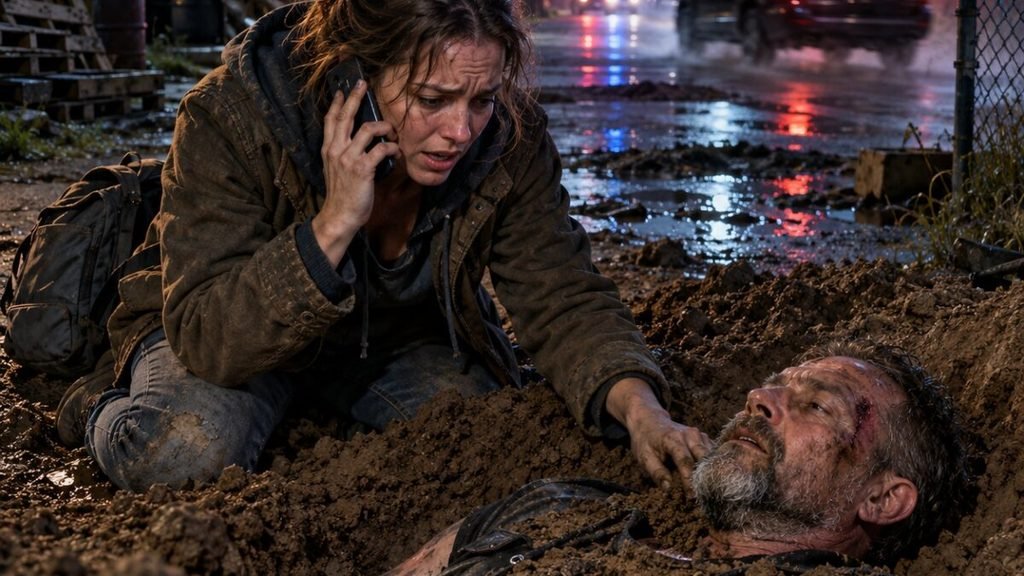
Icould have walked away.
Nobody knew I was behind that warehouse.
Nobody knew I had seen the two men with the shovel.
And at that point in my life, disappearing was the one thing I had become very good at.
Then the dirt moved.
A hand came through it.
And I realized the man they were burying was still alive.
My name is Hannah Brooks.
I was thirty-one years old and homeless in Columbus, Ohio, when it happened.
Not homeless in the way movies show it.
No dramatic collapse.
No single terrible decision.
My mother got sick.
I missed work taking her to chemotherapy.
After she died, I had medical bills, funeral expenses, a dead transmission, and a landlord who raised the rent by $240.
I fell behind.
Then I fell out.
By October, everything I owned fit inside one backpack.
That night, the women’s shelter had filled before I arrived.
I knew an abandoned printing warehouse near the river where a deep loading awning blocked most of the wind.
I had slept there twice before.
I expected concrete and cold.
Instead, I found two men burying someone.
I crouched behind a stack of broken pallets.
About thirty yards away, one man stood beside a shallow trench.
The other shoveled dirt into it.
Inside lay a broad-shouldered man wearing jeans, boots, and a black leather motorcycle vest.
I could see part of a large patch across his back.
IRON VALLEY RIDERS.
For several seconds, I told myself I misunderstood.
Maybe somebody had fallen.
Maybe they were helping him.
Then another shovel of dirt landed across his chest.
I stepped backward.
My sneaker scraped concrete.
One man turned.
I dropped behind the pallets and covered my mouth.
My heart was pounding so violently I thought he would hear it.
For months I had survived by following one rule:
Do not become part of somebody else’s disaster.
Keep moving.
Keep quiet.
Make it until morning.
The street was less than a quarter mile away.
I could leave.
Then I heard a cough.
Weak.
Choked.
But unmistakable.
I raised my head.
The biker’s fingers moved.
He was alive.
I pulled out my prepaid phone.
Eight percent battery.
Before I could dial, headlights swept across the property.
A tractor-trailer was turning onto the industrial road.
The two men panicked.
One dropped the shovel.
They ran toward a dark SUV.
As the vehicle passed beneath a broken security light, I saw part of the license plate.
J82.
I whispered it over and over.
“J82. J82. J82.”
The SUV disappeared.
Seven percent battery.
I dialed 911.
I gave the dispatcher the location, the SUV, the plate characters.
Then she told me units were coming.
I looked at the pit.
The dirt shifted again.
“How long?”
“Stay somewhere safe, ma’am.”
“How long?”
“Police and EMS are en route.”
That wasn’t an answer.
So I ran toward him.
I dropped to my knees in the loose soil.
He looked around fifty.
Gray mixed into his beard.
Blood ran from a cut near his temple, but I avoided moving him.
I used both hands to clear dirt from around his mouth and nose.
“He’s breathing,” I told the dispatcher.
“Keep his airway clear. Do not pull him out.”
My battery showed six percent.
The biker made a sound.
“Hey,” I said.
“Stay with me.”
His eyelids opened halfway.
“My name is Hannah.”
His lips moved.
“What?”
“Go.”
I almost laughed.
Even half buried, this stranger was telling me to save myself.
“No.”
His eyes closed.
“No, you don’t get to do that.”
Sirens began somewhere beyond the warehouses.
I kept talking.
I told him about nothing.
The weather.
How terrible vending-machine coffee was.
How my mother used to say I could argue with a wall until the wall apologized.
Anything to give him a voice to follow.
Red and blue lights finally spilled across the lot.
Paramedics took over.
A police officer approached me.
“You called?”
“Yes.”
“Name?”
“Hannah Brooks.”
“Address?”
That word.
Address.
I looked at him.
“I don’t have one.”
His pen stopped.
Another officer glanced over.
“You’re unhoused?”
“I’m the person who saw what happened.”
The first officer nodded.
“Of course. We just need contact information.”
But I had already heard the difference.
One second I was the witness.
The next I was the homeless witness.
I gave him my prepaid number.
Behind him, paramedics lifted the biker onto a stretcher.
As they loaded him into the ambulance, his eyes opened.
“Where is she?”
A paramedic leaned down.
“Who?”
“The woman.”
I heard him.
“The one who stayed.”
The ambulance doors closed.
By sunrise, I was sitting inside a downtown church warming center charging my phone beside an ancient vending machine.
Four missed calls appeared.
Same number.
It rang again.
“Ms. Brooks? Detective Sarah Nolan.”
My stomach tightened.
“We found traffic-camera footage matching your SUV description.”
I sat straighter.
“And?”
“The plate ends in J82.”
For the first time since the warehouse, someone had confirmed I wasn’t imagining anything.
Then she said, “There’s something else.”
“What?”
“The injured man is awake. His name is Garrett Cole.”
“Okay.”
“He owns Cole Custom Cycles.”
I waited.
Detective Nolan lowered her voice.
“And Hannah, he believes he knows the man you identified.”
I felt cold despite the heated room.
“Who?”
“We need you to come look at photographs.”
Two hours later, Detective Nolan placed four pictures on a table.
The third one made my stomach drop.
Heavy eyebrows.
Narrow mouth.
Same dark work jacket.
“That’s him.”
“You’re certain?”
“He was watching the road.”
She turned the photograph over.
Marcus Vale.
I looked up.
“Who is he?”
Detective Nolan hesitated.
Then said the sentence that changed everything.
“Until three weeks ago, Marcus Vale worked for Garrett Cole.”
I stared at the photograph.
“For the man they tried to bury?”
“Yes.”
Garrett had hired Marcus two years earlier after another repair shop fired him.
He had trusted him.
Then expensive motorcycle parts started appearing in the garage without proper invoices.
Frames showed altered serial numbers.
Titles didn’t match VIN records.
Garrett suspected stolen motorcycles were being stripped and rebuilt through his business without his knowledge.
So he photographed everything.
Copied records.
Contacted investigators.
Marcus discovered Garrett had been asking questions.
What he apparently didn’t know was how much evidence Garrett had already turned over.
The SUV from the warehouse belonged to Marcus’s brother-in-law.
Its license plate ended in J82.
Police arrested Marcus and the second man that afternoon.
I thought that would end my part.
It didn’t.
Three days later, Garrett came looking for me.
I was eating soup at an outreach center when a shadow fell across the table.
“You should still be in the hospital,” I said.
He smiled painfully.
“They were tired of me complaining.”
His shoulder was strapped beneath his jacket.
There were bruises along his jaw.
He sat across from me.
“You remember me?”
“You were easier to recognize without the dirt.”
That made him laugh, then regret laughing.
He pulled a white envelope from his coat.
“I came to thank you.”
I knew immediately what it was.
“No.”
“You don’t know what’s inside.”
“Money.”
“Yes.”
“No.”
His eyebrows rose.
“Hannah, you saved my life.”
“I didn’t do it so you’d buy it from me.”
That landed.
He slowly put the envelope away.
“All right.”
I expected him to leave.
Instead he asked, “What would actually help?”
I stared at him.
People had asked me what happened.
Why I was homeless.
Whether I had family.
Whether I had made “bad choices.”
Almost nobody asked what I needed next.
“My ID was stolen at a shelter.”
Garrett waited.
“I need a mailing address. Somewhere I can shower before interviews. And one employer willing to see the five years I worked in elder care instead of the eleven months I spent homeless.”
“Anything else?”
“Yes.”
I looked directly at him.
“If you decide to help, don’t disappear next week.”
He didn’t swear he would fix my life.
He just nodded.
“Fair.”
That mattered more.
Garrett introduced me to a caseworker named Paula.
Four days later, I had temporary identification documents.
The transitional housing program Paula worked with had a small room available for six weeks.
Shared kitchen.
Strict curfew.
Thin walls.
I almost cried when they handed me the key.
Not because it was beautiful.
Because I could leave my backpack in the room and know it would still be there when I came back.
Garrett knew the director of an assisted-living facility.
I made him promise one thing.
“You can tell them I’m applying.”
“Okay.”
“You cannot tell them to hire me.”
“Okay.”
“I mean it.”
“Hannah, I heard you the first two times.”
I didn’t get the job.
The manager chose someone with more recent experience.
That night, I sat on my bed staring at the rejection email.
Garrett called.
“They said no.”
He was quiet.
Then:
“Okay.”
I snapped.
“Okay?”
“What do you want me to say?”
“I don’t know. Something inspirational.”
“I’m terrible at inspirational.”
Despite myself, I laughed.
“Then what?”
“We try somewhere else tomorrow.”
No speech.
No claim that everything happened for a reason.
Just tomorrow.
The second facility asked why I wanted to return to caregiving.
I told the truth.
“My mother got sick. I spent almost a year helping her with appointments, medications, bathing, all the things people don’t talk about.”
The director waited.
“I learned how terrifying it is to feel like your body is becoming everybody else’s problem.”
I swallowed.
“I don’t ever want the people I care for to feel that way.”
She looked at my résumé.
“Can you start Monday?”
Three days later, I clipped a badge onto navy-blue scrubs.
HANNAH BROOKS
RESIDENT CARE ASSOCIATE
I went into the bathroom and stared at it.
Not homeless.
Not victim.
Not witness.
My name.
Then my phone rang.
Detective Nolan.
“The defense wants to challenge your testimony.”
My stomach dropped.
Marcus’s lawyer planned to question my sleep deprivation.
My shelter history.
My lack of permanent housing.
Even the fact that I had originally called the SUV black when camera footage showed it was dark navy.
One line in their filing stayed with me.
Unstable living circumstances may undermine observational reliability.
I read it until the words blurred.
They weren’t putting Marcus’s character on trial.
They were putting my worst year on trial.
For two days, I decided I wouldn’t testify.
Garrett found me outside the outreach center after work.
“I might walk away.”
He leaned against the wall.
“Okay.”
I frowned.
“You really need a new word.”
He smiled.
“It’s your decision.”
“If I don’t testify, it hurts your case.”
“Maybe.”
“They tried to kill you.”
“Yes.”
“You want me there.”
He looked at me for a long moment.
“I want you to sleep at night.”
I said nothing.
“You kept me alive, Hannah. That doesn’t mean you owe me your peace.”
That answer changed my mind.
Not because he pressured me.
Because he didn’t.
The next morning, I called the prosecutor.
“I’ll testify.”
Thursday, I stood outside a Franklin County courtroom holding coffee I never drank.
Through the door window, I could see Marcus.
Ten feet away.
Closer than he had been at the warehouse.
When I entered, Garrett sat in the second row.
Beside him were eight men and three women from his riding club.
No dramatic entrance.
No leather-clad intimidation show.
They simply sat there.
Garrett met my eyes.
One nod.
I walked to the witness stand alone.
The prosecutor asked what I saw.
I told her.
Then the defense lawyer stood.
“Ms. Brooks, you had slept poorly that week?”
“Yes.”
“You had no fixed residence?”
“Correct.”
“It was nighttime.”
“Yes.”
“You described the SUV as either black or dark blue.”
“Yes.”
“So some details were unclear.”
I could feel every old humiliation trying to climb back into my throat.
Employers seeing the address line blank.
Receptionists changing their tone.
People discussing homelessness as though it erased the person standing in front of them.
I breathed.
“Some details were unclear.”
The lawyer paused.
“So your memory was imperfect?”
“Yes.”
He almost smiled.
Then I added:
“Imperfect doesn’t mean useless.”
The courtroom went quiet.
When the prosecutor stood again, she asked one question.
“What do you remember without doubt?”
I looked at Marcus.
Then at Garrett.
“I remember hearing a man cough beneath the dirt.”
My hands stopped shaking.
“I remember clearing his face so he could breathe.”
I looked back at the jury.
“I remember the man near the road turning toward me.”
Marcus lowered his eyes.
“I remember their SUV leaving.”
Then I said:
“And I remember repeating J82 to myself over and over because I was scared I’d forget before police arrived.”
The prosecutor displayed the traffic image.
A dark navy SUV.
Plate ending J82.
Cell-location records placed Marcus nearby.
Records from Garrett’s garage established motive.
Physical evidence connected both men to the warehouse.
My testimony didn’t have to stand alone.
It connected the pieces.
When I stepped down, nobody called me “the homeless woman.”
They called me Hannah Brooks.
Outside, Garrett asked, “You okay?”
“Ask tomorrow.”
He smiled.
“Fair.”
Before we left, the prosecutor caught us.
“The defense has asked to discuss a plea.”
I stared at her.
“Because of today?”
“Because the evidence is now very difficult to explain away.”
Marcus eventually pleaded guilty to charges that sent him to prison for years.
The second man did too.
But that wasn’t the ending that mattered most to me.
Six months later, I stood outside Apartment 3C holding my own key.
A studio.
Old carpet.
Tiny kitchen.
Secondhand couch.
Garrett contributed exactly one item.
A hideously ugly brass lamp he found at a yard sale.
“You cannot be serious.”
“It has character.”
“It has several diseases.”
He carried it inside anyway.
I placed my backpack on the floor.
Then stopped.
For over a year, I had kept that bag within arm’s reach.
Even while sleeping.
Everything important had to be ready to move.
That night, I left it beside the couch.
Then walked into the bedroom without it.
I cried harder over that than I had over the lease.
I stayed at the assisted-living center.
Eventually I became a senior aide.
Garrett returned to his motorcycle shop.
We became friends in the strangest possible way.
Neither of us ever called the other a savior.
That would have made things too simple.
I kept him breathing long enough for paramedics to arrive.
He helped me remove barriers I had been fighting alone.
Those are different things.
A year later, Garrett’s riding club partnered with the outreach center.
Mechanics repaired donated cars for people leaving shelters.
Others offered rides to interviews.
I helped people replace IDs, prepare résumés, and figure out housing paperwork.
The nonprofit director asked us what to call the new program.
Garrett suggested “Hannah’s Hope.”
I threatened to quit.
“What, then?” he asked.
I thought about that night.
About lying invisible behind pallets.
About how easily people had looked through me before and after it.
“Seen,” I said.
That became the program’s name.
SEEN.
One winter evening, I was locking the center when I noticed a woman outside.
Young.
Wet coat.
Backpack against her chest.
She looked through the window, then started walking away.
I knew that hesitation.
The feeling that every doorway belonged to somebody with a better reason to enter.
I opened the door.
“Hey.”
She turned.
“You need somewhere warm?”
“I don’t have money.”
“I didn’t ask.”
She stared at me.
I stepped aside.
“Come inside.”
Across the street, Garrett was loading tools into his truck.
He saw us.
He didn’t interrupt.
The woman walked through the doorway.
I closed it behind her.
Years earlier, people had decided my lack of an address made me less believable.
A criminal defense attorney had tried to turn homelessness into proof that my eyes and memory could not be trusted.
They were wrong.
I had seen Garrett when two other people hoped the world wouldn’t.
Later, Garrett saw me when much of the world already hadn’t.
That is what I remember most.
Not the grave.
Not the courtroom.
Not even the apartment key.
I remember kneeling in the dirt beside a stranger who barely had enough air left to whisper one word.
“Go.”
And I remember the answer I gave him.
“No.”
At the time, I thought I was choosing not to abandon him.