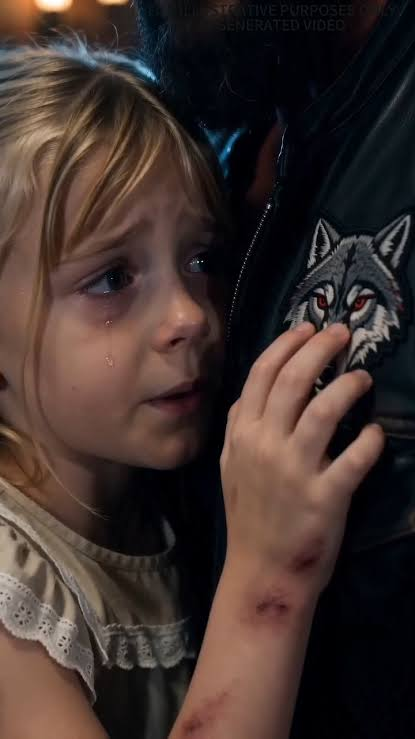
By twelve-thirty, Millie’s Diner was so crowded that every time the front door opened, three people seemed to squeeze through it before one could leave.
The little roadside restaurant sat just off Highway 64 outside Cleveland, Tennessee, where the pavement curved through low wooded hills before stretching south toward Chattanooga.
It was the kind of place travelers noticed only because of the faded red-and-white sign rising above the gravel lot, yet once they stopped,
many of them remembered it—the cracked vinyl booths, the handwritten pie menu taped beside the register,
the smell of bacon grease and strong coffee that had seeped so deeply into the walls that even a fresh coat of paint could never quite cover it.
Outside, more than thirty motorcycles stood in two uneven rows beneath the hard Tennessee sun, their chrome flashing whenever a truck rolled past on the highway.
Most were Harleys, heavy touring machines and road-worn cruisers with saddlebags dusty from miles of dry pavement, and anyone driving past might have assumed that some outlaw club had taken over the diner.
They would have been wrong.
The riders had spent the morning participating in a charity run that raised money for the pediatric wing of a hospital in Chattanooga, and although they looked intimidating enough—
leather vests, weathered faces, tattooed arms, heavy boots—the loudest argument they had managed all afternoon concerned whether banana cream pie counted as a legitimate lunch.
“It has bananas,” Caleb Dunn announced from the next table, pointing his fork as though he were presenting evidence before the Supreme Court. “Bananas are fruit. Fruit is healthy. Therefore, pie is healthy.”
Nadine Brooks, whose silver hair was braided down the back of her leather vest, stared at him over the rim of her coffee mug.
“That logic explains your last three divorces.”
The table erupted.
Caleb placed one hand dramatically against his chest. “Those women simply couldn’t handle a man of intellectual depth.”
“They couldn’t handle you leaving motorcycle parts in the bathtub.”
“That happened once.”
“Three times.”
More laughter followed, rolling through the corner of the diner until even one of the truckers at the counter smiled.
Only Mason Callahan did not join in.
He sat at the booth nearest the window, one broad shoulder turned toward the room while he watched traffic move along the highway beyond the glass.
At fifty years old, Mason had reached the age when a man’s history began showing itself whether he wanted it to or not;
there was gray threaded through his dark beard, deep creases beside his eyes, and enough scars across his knuckles to suggest that, at several points in his life, he had mistaken endurance for wisdom.
Most people called him Wolf.
The nickname had started because of the patch on the back of his vest—a gray wolf standing beneath a silver crescent moon—
but over the years it had become so thoroughly attached to him that even people who knew his real name rarely used it.
To strangers, Wolf looked dangerous.
He was six-foot-three, broad through the shoulders, with scarred hands and the unsettling habit of looking directly at whoever spoke to him without feeling obligated to fill every silence.
Mothers occasionally pulled their children closer when he walked through gas stations; nervous clerks sometimes watched his hands instead of his face; and more than once, someone had crossed a street rather than pass him on the sidewalk.
Mason had stopped taking offense years ago.
People saw leather, tattoos, scars, and motorcycles, then wrote the rest of the story themselves.
It saved time.
The people who actually knew him understood something different.
They knew Mason carried jumper cables, bottled water, a first-aid kit, and two emergency blankets in his saddlebags because he had spent one freezing night under a highway overpass when he was twenty-two and had never forgotten what cold felt like when nobody stopped.
They knew he had once ridden eighty miles in the rain because Nadine’s grandson had been stranded beside a broken-down pickup.
They knew he quietly covered the final three thousand dollars when the previous year’s hospital charity ride fell short of its fundraising target, then threatened Caleb with bodily harm if he told anyone where the money had come from.
Caleb had told everyone.
Mason had not harmed him.
Which, Caleb frequently argued, proved he was becoming soft.
At that moment, however, Mason wasn’t thinking about any of those things. He was thinking about the burger cooling on his plate and wondering whether he had enough patience to listen to Caleb defend banana cream pie for another twenty minutes.
He lifted the burger.
Then he noticed someone standing beside the table.
At first, he assumed one of Millie’s waitresses had come to refill his coffee, so he shifted his cup toward the edge without looking.
Nobody poured.
Mason glanced down.
A little girl stood beside him.
For several seconds, he said nothing.
She couldn’t have been older than nine.
Her blond-brown hair hung in tangled strands around a face streaked with sweat and dirt, while the oversized yellow T-shirt she wore was torn near the hem and stained green along one side,
as though she had fallen—or hidden—in wet grass. One shoelace had come undone. Her sneakers were muddy. A shallow scratch ran across her left knee.
Yet none of those details disturbed Mason as much as the way she was breathing.
Too quickly.
Too quietly.
A child trying desperately not to make noise.
Mason slowly lowered his burger.
“Hey there.”
The girl flinched.
Not dramatically, but enough.
Mason’s expression changed.
He had seen that reaction before.
Not often in children, thank God, but often enough in adults who had spent too much time around someone unpredictable.
Sudden movement became dangerous.
Loud voices meant something worse might follow.
A person learned to make themselves smaller because smaller things were harder to notice.
Mason wiped his hands on a napkin and leaned back rather than toward her.
“I’m not gonna touch you,” he said gently. “Okay?”
The girl’s eyes moved to his face, then immediately past him toward the entrance.
Mason followed the glance but saw only the diner door, sunlight glowing through its dusty glass.
When he looked back, the girl’s hands were trembling.
“Are you lost?”
She shook her head.
“Your folks here?”
Another shake.
Mason glanced toward Nadine.
She had already noticed.
Her laughter had disappeared, although she remained seated and deliberately looked elsewhere so the child would not feel surrounded.
Smart woman.
Mason returned his attention to the girl.
“What’s your name?”
She didn’t answer.
Instead, she stared at his leather vest.
More precisely, at something over his shoulder.
The wolf.
Mason could see the recognition happen in her face, but he could not understand it.
Her eyes widened.
Then, unexpectedly, relief appeared beneath the fear.
Only for a moment.
She stepped closer.
“You’re him.”
Mason frowned.
“I’m who?”
“The wolf.”
Something about the way she said it made his stomach tighten.
It wasn’t a question.
Before he could ask what she meant, the girl glanced toward the front windows again and whispered, “You have to leave.”
Mason remained still.
“What?”
“You have to leave.”
“Why?”
She looked around the diner, at the bikers eating lunch, the truckers at the counter, the elderly couple sharing pie two booths away.
“All of you.”
Mason placed both forearms on the table.
“Sweetheart, tell me what’s happening.”
Her lower lip trembled.
“They’re coming.”
Across the diner, Caleb stopped laughing.
Mason hadn’t signaled him.
He hadn’t needed to.
Men who had ridden together long enough developed their own language, and Caleb had recognized the subtle change in his oldest friend’s posture.
“Who’s coming?” Mason asked.
The girl opened her mouth.
Nothing came out.
“You’re safe right now.”
She shook her head so hard that tangled hair fell across her face.
“No.”
“You’re inside a diner full of people.”
“That doesn’t matter.”
“Why not?”
“Because Darren gets mad.”
The name meant nothing to Mason.
“Who’s Darren?”
The girl looked at him as though answering might summon the man.
Mason lowered his voice.
“Is Darren your dad?”
“No.”
“Family?”
“No.”
“Do you live with him?”
Her eyes filled with tears.
“I don’t want to.”
That answer was enough to change the situation completely.
Mason looked toward the counter.
Millie Carson stood behind the register, sixty-eight years old and built with the sturdy confidence of a woman who had spent four decades throwing drunks out of her own restaurant. Their eyes met.
Mason tapped one finger against the tabletop.
Once.
Millie understood.
Her hand disappeared beneath the counter toward the phone.
Mason turned back to the girl.
“Listen to me. Nobody here is going to make you go anywhere until we understand what’s happening. All right?”
“You don’t understand.”
“Then help me.”
“He said if she tried to leave again—”

