A fictional story, written to honor the dogs who wait.
Every morning, the old Border Collie took her place beside the empty rocking chair by the window, and she did not leave it until the church bell rang at noon.
1. The Chair by the Window
The farmhouse at the edge of the valley had one window that mattered more than all the others. It faced east, toward the hills, and in the morning the sun came through it in a wide, warm band across the wooden floor. Beside that window stood a rocking chair, old and worn, its arms polished smooth by years of hands. For as long as anyone could remember, Martha Ellison had sat in that chair every morning with her tea.
Martha was eighty-four when she died, in the winter. She had lived in the house for more than sixty years, and she had raised her children there, and buried her husband there, in the small churchyard down the road, and she had grown old there with a steadiness that her neighbors admired. Every morning, she rose early, made tea in the blue pot, and carried her cup to the window chair. She watched the light come over the hills. She watched the birds at the feeder. She talked to Tess, her Border Collie, who lay at her feet with her head on her paws, listening as if every word mattered.
Tess was ten years old, black and white, with a graying muzzle and a slow, careful way of moving that came with age. She had been Martha’s shadow for a decade. Where Martha went, Tess went. When Martha sat, Tess lay down beside her. When Martha stood, Tess stood too, ready. They understood each other in the quiet way that old friends do, without needing many words.
When Martha died, the house went quiet in a way Hannah had not expected. Hannah Ellison was Martha’s granddaughter, thirty-four, a schoolteacher from town, and she had moved into the farmhouse in the spring to sort through her grandmother’s things and decide what to do with the place. She had expected grief. She had expected dust and old letters and difficult decisions. She had not expected Tess.
Tess did not seem lost, exactly. She ate. She went outside. She slept in her bed by the stove. But every morning, at the same hour Martha used to rise, Tess walked to the window, settled herself beside the empty rocking chair, and stayed there. She did not lie down the way she used to, curled at Martha’s feet. She sat upright, alert, her ears forward, her eyes on the door, as if she were keeping watch. She stayed until noon, when the church bell rang down in the valley — one, two, three, all the way to twelve — and only then did she rise, stretch, and walk slowly to the kitchen for her water.
Hannah watched this for a week before she understood what she was seeing. Tess was guarding the chair. She was keeping Martha’s place. She was waiting for the morning to be the way it had always been: tea, sunlight, and the soft creak of the rockers on the wooden floor.

Hannah tried, gently, to change the routine. She put Tess’s bed beside the chair, thinking the old dog might be more comfortable. Tess sniffed the bed, looked at Hannah, and sat down again in her usual spot, on the bare floor. Hannah tried a blanket. Tess nosed it aside. Hannah tried sitting in the chair herself, just for a moment, to see what would happen. Tess stood up at once, walked around to the front of the chair, and looked at Hannah with a steady, unblinking gaze — not angry, not afraid, just certain. Not yet, the look said. Not like this.
Hannah got up. She felt foolish, and a little stung, and then she felt something else: respect. Tess was not being stubborn. She was being faithful. She had kept this post for ten years, in her own way, and she was not going to abandon it now just because the chair was empty. Hannah went to the kitchen and made tea, and she drank it standing at the counter, looking out at the hills, and she thought about her grandmother — about the mornings in this kitchen, the blue pot, the way Martha would hum while the kettle boiled — and she felt the grief rise in her like water, slow and cold.
She had come here to sort the house and sell it, most likely. That was the plan she had made with her mother on the phone: clean it out, fix what needed fixing, put it on the market before winter. It was a sensible plan. The house was too big for one person, too far from town, too full of things no one needed anymore. But standing in the kitchen that morning, listening to the silence where the rocking chair should have been creaking, Hannah was not sure she could do it. Not yet. Not while Tess was still keeping watch.
2. The Chair Must Move
The problem, Hannah told herself, was practical. The window chair took up the best light in the house, and the room needed rearranging if anyone was going to live there. The rug was worn thin where the rockers had moved back and forth for decades. The floorboards underneath were scratched. The chair itself was old, and the joints were loose, and it creaked in a way that made Hannah think of her grandmother every time the wind moved it — which was often, and which hurt, every time.
So one morning in late April, Hannah decided to move it. Not far. Just across the room, against the wall, where it would be out of the way and the window could be used for something else — a reading nook, maybe, or a small desk. She waited until Tess had gone outside to do her morning rounds of the yard, and then she took hold of the chair’s arms and dragged it, slowly, across the floor. The rockers scraped. The joints groaned. Hannah’s heart pounded in a way that seemed out of proportion to moving a chair.
Tess came back inside before Hannah had finished. The old dog stopped in the doorway. She looked at the empty space by the window. She looked at the chair, halfway across the room, tilted at an unfamiliar angle. And then she walked, quite calmly, to the chair, and stood in front of it, blocking Hannah’s path.

Hannah tried to step around her. Tess moved with her, gently, without haste, keeping herself between Hannah and the chair. Hannah tried the other side. Tess moved again. It was not aggressive. Tess did not growl. She did not bare her teeth. She simply stood there, solid and certain, and looked up at Hannah with those dark, steady eyes. No, the look said. This is not right. Put it back.
Hannah laughed, a short, startled sound. “Tess,” she said, “it’s just a chair.” Tess did not move. Hannah put her hands on her hips. “Tess, I need the room. I need —” She stopped. She did not know what she needed. She needed the house to feel less like a museum. She needed to stop expecting her grandmother to come around the corner with a cup of tea. She needed to be able to move a chair without feeling as if she were erasing someone.
She sat down on the floor, right there in the middle of the room, and she cried. Not loudly. Just quiet tears, the kind that come when you are tired and far from home and the person you miss is not coming back. Tess came to her at once and pressed her head against Hannah’s knee, and Hannah put her arms around the old dog’s neck and held on, and Tess stood there, patient and warm, and let her.

When Hannah’s tears stopped, she wiped her face with her sleeve, and she looked at Tess, and she said, “All right. All right, girl. We’ll put it back.” And together — Hannah pulling, Tess walking beside her as if supervising — they dragged the rocking chair back to its place by the window. The rockers settled into the worn grooves in the floorboards, exactly where they had always been, and the chair gave a small, familiar creak, and Tess walked around it once, sniffed it carefully, and then sat down beside it in her usual spot, facing the door.
Hannah stood there for a long time, looking at the chair. She thought about her grandmother, sitting there every morning with her tea, watching the light come over the hills. She thought about Tess, keeping watch beside an empty chair, day after day, because that was what love looked like when the person you loved was gone: you kept their place. You waited. You did not move the chair.
That afternoon, Hannah called her mother. “I’m not selling the house yet,” she said. “I need more time. Tess needs more time. We both do.” Her mother was quiet for a moment, and then she said, “All right, honey. Take all the time you need.” Hannah hung up, and she went back to the window, and she stood there beside Tess, and she watched the sun go down over the hills, and she felt, for the first time since she had arrived, that she was exactly where she was supposed to be.
3. Tea on the Windowsill
The next morning, Hannah did something different. She rose early, made tea in the blue pot, and carried two cups to the window — one for herself, and one she set, very carefully, on the windowsill beside the rocking chair. Then she sat down on the floor beside Tess, cross-legged, with her back against the wall, and she waited for the sun.
Tess looked at her. She looked at the cup on the windowsill. She looked back at Hannah. And then, slowly, she lay down — not in her upright, watchful pose, but curled, the way she used to lie at Martha’s feet, her head resting on her paws, her eyes half-closed in the morning light. Hannah reached out and rested her hand on Tess’s back, feeling the slow rise and fall of her breathing, and she did not speak. There was nothing to say. The sun came over the hills, and the light moved across the floor, and the rocking chair stood empty beside them, and it did not feel empty in quite the same way anymore.
Hannah began to do this every morning. Tea in the blue pot. A cup on the windowsill. Herself on the floor beside Tess, until the church bell rang at noon. At first, it felt strange — sitting on the floor of her grandmother’s house like a child, drinking tea in silence with a dog. But slowly, it began to feel like the most natural thing in the world. She learned the rhythm of the mornings: the birds at the feeder, the light moving across the rug, the way Tess’s ears twitched at the sound of a truck on the road, the way the chair creaked once, softly, when the sun warmed the wood.

She began to talk to Tess, the way Martha used to. She told her about school, about the children in her class, about the books she was reading. She told her about her grandmother — the stories she remembered, the smell of her kitchen, the way she had taught Hannah to make tea when she was small, standing on a stool to reach the counter. Tess listened to all of it with great seriousness, her head on her paws, her eyes on Hannah’s face.
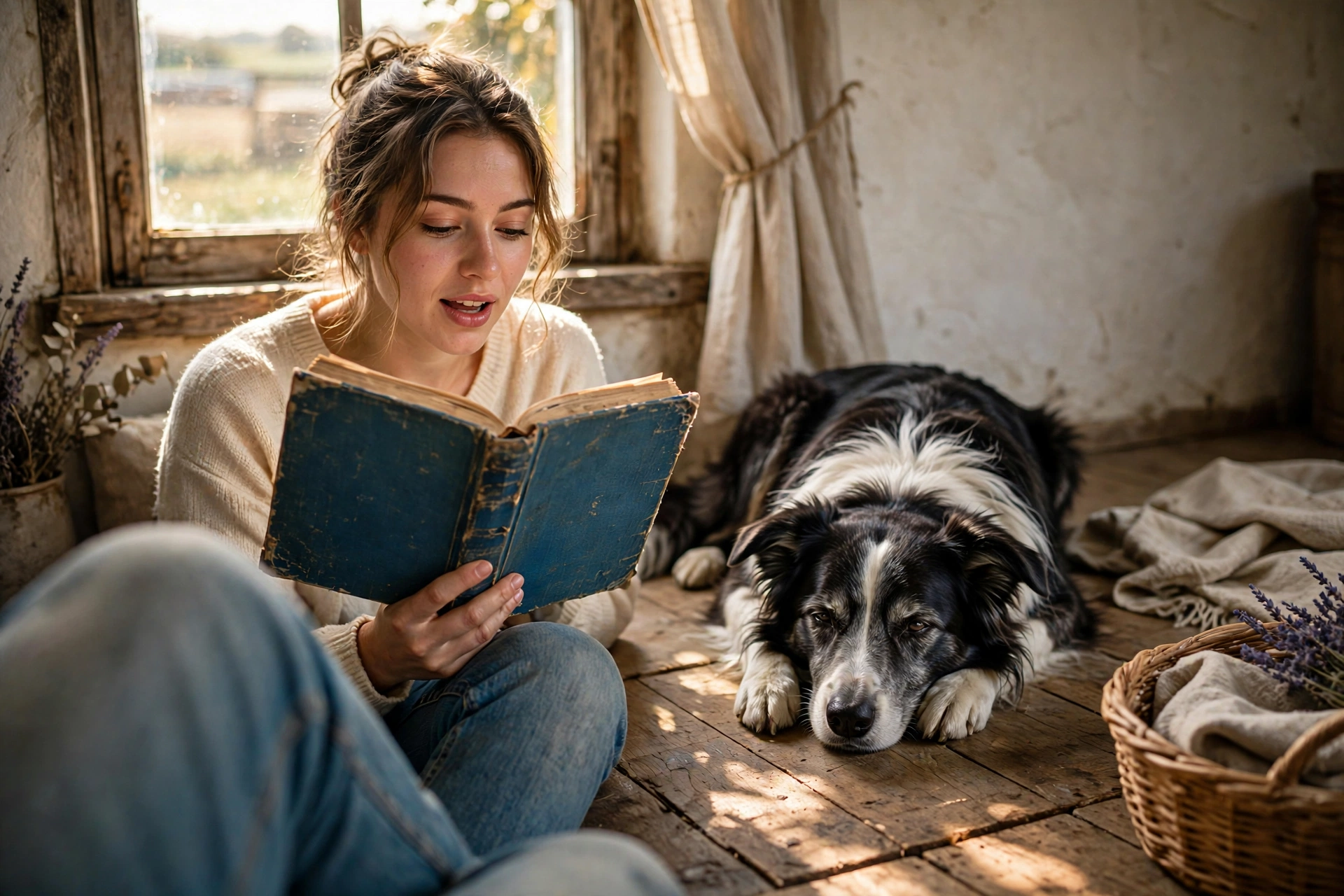
One morning, Hannah brought a book with her and read aloud, quietly, while Tess slept. It was a book of poems her grandmother had loved, with a worn blue cover and notes in the margins in Martha’s handwriting. Hannah read a poem about hills and morning light, and her voice caught, and she stopped, and Tess lifted her head and looked at her, and Hannah laughed through her tears and said, “It’s all right, girl. It’s just a poem. Grandma liked this one.” Tess put her head back down, and Hannah kept reading, and the morning went on, gentle and unhurried, the way mornings in that house had always gone.
The neighbors began to notice a change. Mrs. Alvarez from down the road, who brought eggs on Tuesdays, said, “You look better, honey. Less tired.” The postman said, “Tess looks happier. She’s got someone to sit with now.” Hannah did not know if that was true, exactly. Tess still guarded the chair. She still sat upright and watchful until noon. But now, when the bell rang, she would rise and come to Hannah, and press her head against Hannah’s knee, and Hannah would scratch behind her ears, and they would go to the kitchen together for lunch, side by side, the way Martha and Tess used to go.
Hannah began to understand something she had not understood before. Tess had not been guarding an empty chair. She had been guarding a morning — a way of being together, quietly, in the light, with tea and a dog and nothing that needed to be done. And Hannah, by sitting on the floor beside her, had not taken Martha’s place. She had joined it. She had learned the morning, the way Tess had learned it, one quiet day at a time.

4. The Afternoons by the Chair
By summer, the house had changed, in small ways. Hannah had cleaned the windows and aired the rooms. She had planted geraniums in the pots by the door. She had fixed the loose step on the porch. She had not moved the rocking chair. It stayed by the window, in its worn grooves, and Tess stayed beside it every morning until noon, and Hannah sat on the floor beside them both with her tea.
In the afternoons, Hannah began to read by the chair. She would bring a book and a cushion, and she would sit on the floor in the patch of sun by the window, and Tess — released from her morning post by the noon bell — would lie beside her, stretched out flat, snoring softly. Hannah read novels her grandmother had loved, and new books from the library in town, and sometimes she read aloud, just to hear a voice in the house. Tess did not seem to mind. She slept through all of it, her paws twitching as she dreamed.
One afternoon, Hannah’s mother came to visit. She stood in the doorway of the front room and looked at her daughter sitting on the floor beside an old dog, reading in the sun, and she said, “Oh, honey. You look just like your grandmother.” Hannah looked up and smiled. “I know,” she said. “I think that’s the point.”
Her mother sat in the rocking chair — carefully, as if asking permission — and the chair creaked under her, and Tess lifted her head and looked at her, and then, to Hannah’s surprise, Tess put her head back down and went back to sleep. Her mother sat there for a long time, rocking gently, looking out at the hills, and she did not speak. When she finally stood up, she put her hand on the back of the chair and said, quietly, “She would have liked this. She would have liked knowing the chair was still here, and the dog was still here, and you were here, too.”
That evening, after her mother had gone, Hannah sat on the porch with Tess and watched the stars come out over the valley. She thought about the plan she had made in the spring — clean the house, sell it, go back to town — and she realized, without surprise, that the plan had quietly changed. She did not know how long she would stay. She did not know if she would stay forever. But she knew she was not ready to leave, and Tess was not ready to leave, and the chair was not going anywhere. That was enough, for now. It was more than enough.
She began to teach in the fall at the small school down the valley, a job she had not expected to find, and she came home every afternoon to Tess and the window chair and the house that was slowly becoming hers — not by taking it over, but by living in it, morning by morning, the way her grandmother had. She kept the blue pot. She kept the morning tea. She kept the cup on the windowsill. And every morning, she sat on the floor beside Tess, and together they waited for the sun, and for noon, and for whatever the day would bring.
5. Someone Sits Nearby
Winter came again, a year after Martha died, and the hills turned white, and the light through the window turned pale and clear. Tess was slower now. Her muzzle was whiter. Some mornings, she needed a hand to stand. But every morning, she still walked to the window, and she still took her place beside the rocking chair, and she still stayed until the church bell rang at noon. Hannah still sat on the floor beside her, with her tea, and her book, and her hand resting on Tess’s back.
One cold morning in January, Hannah woke to find Tess already at the window, sitting upright in the thin winter light, waiting. Hannah made tea, set a cup on the windowsill, and sat down beside her, and they watched the sun come up over the snow-covered hills together, in silence, the way they always did. And Hannah thought about her grandmother, and about the mornings in this house, and about the way love does not end when a person dies — it changes shape. It becomes a chair by a window. It becomes a dog who keeps watch. It becomes a granddaughter who learns to sit on the floor and wait for the bell.
Tess is still keeping her post. That has not changed, and Hannah does not expect it to. The chair stays. The bell still rings at noon. The tea is still in the blue pot. But now, when the morning comes, Tess does not wait alone. Someone sits nearby. Someone reads aloud. Someone rests a hand on her back and says, in a quiet voice, “I’m here, girl. I’m here.” And Tess, who has guarded this window for ten years, sighs in her sleep, content, and waits for noon — not because she is holding a place for someone who is gone, but because she is keeping a morning for someone who is still here.
On a clear afternoon in February, Hannah sat by the chair with her book, and Tess lay beside her in the sun, and the rocking chair stood empty in the light, and it did not feel empty at all. It felt full — full of mornings, full of tea, full of a grandmother’s humming, full of a dog’s faithful watch, full of a granddaughter who had come home and stayed. Hannah closed her book, and she put her hand on the chair’s arm, feeling the smooth, worn wood under her palm, and she said, softly, “Thank you, Grandma.” Tess lifted her head, looked at her, and put her head back down. The sun moved across the floor. The bell would ring at noon tomorrow, as it always did. And they would be there, together, waiting for it — the dog, the chair, and the girl who had learned to sit beside them both.