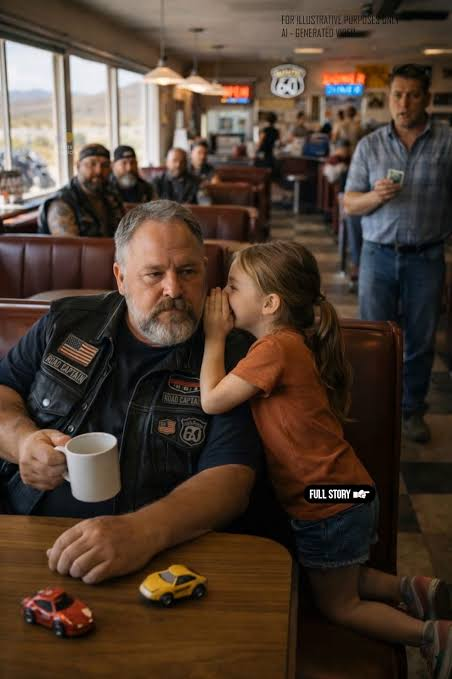
The late afternoon sun slanted low across the Mojave, bleeding through the road-filmed plate glass of the Red Mesa Diner and spilling amber across the cracked vinyl of the corner booth. Outside,
Route 66 stretched east and west like an unstitched seam across the scorched alkaline flat.
The wind carried a dry, scouring heat that rattled the aluminum awnings and pushed tumbleweeds against the concrete foundation.
Inside, the air smelled of stale lard, bleach, chicory coffee, and thirty years of unwashed grease trap.
Silas sat with his broad back wedged into the corner where the wood paneling met the window.
He was a massive man whose frame had settled into the dense, immovable weight of seasoned hardwood.
His hands, corded with thick veins and mapped with pale, jagged scars from dropped transmissions and barroom knuckle-dusters, were wrapped around an off-white ceramic mug.
The coffee inside had gone stone cold half an hour ago, forming a dark, iridescent sheen on its surface, but he held it anyway.
It gave his fingers something to grip when the silence became too loud.
He was seventy-one years old. His beard fell to his collarbone, thick and white as alkali dust, hiding the tight set of a jaw that had spent seven years clenched shut against the world.
He wore his usual working clothes: a heavy plaid wool-blend flannel over a grey henley, dark canvas trousers stiffened with grease at the knees, and oiled steel-toed work boots that had walked out of a dozen different state yards.
On his head sat a faded oilskin ballcap, the logo long worn away by wind and sun.
Silas did not look up when the bell above the screen door gave its rusty, two-tone chime.
The sound was part of the background, along with the hum of the fluorescent tube over the pie carousel, the rhythmic scrape of the cook’s spatula on the flat-top, and the heavy low-frequency shudder of eighteen-wheelers thundering down the bypass two miles south.
Travellers stopped here when their radiators hissed or their children screamed for soda; they stayed twenty minutes, left three crumpled dollar bills on the laminate, and vanished back into the western glare.
Silas was none of those things. He lived in the two-room cinderblock cottage behind the defunct Sinclair station a quarter-mile down the service road.
Every afternoon at four o’clock, he walked to this booth, ordered black coffee from a waitress named Marge who had stopped asking about his life in 2021,
and sat until the red sun dipped behind the jagged ridge of the Calico Mountains.
He was waiting out the clock.
There was nothing else to do with a life after the only two people who had ever looked at you with tenderness were buried in the hard caliche clay outside Needles.
A shadow fell over the yellowed table, cutting the warm light off his knuckles.
Silas didn’t move at first. He assumed it was Marge with the glass pot, coming to top off the cold mud in his mug with fresh, burnt mud. But the silence dragged.
There was no clink of tempered glass on ceramic, no scent of scorched grounds, no sigh of fallen arches in rubber-soled nurse shoes.
There was only the faint, unmistakable smell of old, sun-baked cowhide and the subtle creak of heavy leather.
Silas slowly lifted his chin.
Standing at the edge of the booth was a young girl.
She could not have been older than twelve. She was built slight and straight, like a desert willow that grew hard because the wind never let it soften.
She wore a heavy black motorcycle jacket—an authentic Schott Perfecto, its steerhide aged to a dull charcoal, the belt buckle swinging loose at her hip, the sleeves rolled twice at the wrists so her small hands could clear the cuffs.
It was absurdly oversized on her small shoulders, yet she carried it without slouching. Underneath was a plain white cotton undershirt, tucked into dusty black jeans that vanished into scuffed engineer boots with tarnished brass roller buckles.
Her hair was long, dark, and straight, falling loose around a pale, sun-freckled face. But it was her eyes that pinned Silas to the vinyl cushion.
They were deep, luminous brown, fringed with thick dark lashes, set beneath straight, stubborn brows.
They were eyes he had seen look back at him from the vanity mirror of an old trailer every morning for thirty years before cancer took his wife, Martha.
They were the exact eyes of his daughter, Clara, before an eighteen-wheeler hydroplaned across the center line on
Interstate 40 during a flash flood seven years ago, ripping Clara and her husband out of this world in a fraction of a second and leaving behind a shattered, five-year-old child named Maya.

