Some photographs preserve more than a person’s appearance. They preserve a moment in history that the world must never forget.
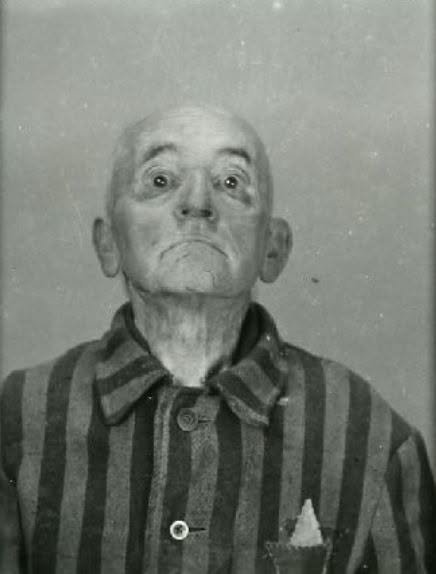
This haunting photograph shows Karl Liebl, an elderly Jewish merchant whose final days were spent inside the Auschwitz concentration camp.
He was 77 years old when he arrived.
Just three days later, he was dead.
His story is one of the countless personal tragedies hidden within the history of the Holocaust.
A Life Before the Holocaust
Karl Liebl was born on January 11, 1864, in Groß Meseritsch, a town now known as Velké Meziříčí in the Czech Republic.
According to surviving Auschwitz records, Karl worked as a merchant.
He had lived through more than seven decades of history, experiencing a world that changed dramatically during his lifetime.
He had spent 77 years building a life before becoming one of the victims of Nazi persecution.
But his final chapter would unfold in one of history’s most infamous concentration camps.
Arrival at Auschwitz
On October 24, 1941, Karl Liebl arrived at Auschwitz.
Upon entering the camp, he was registered as prisoner number 22074.
Like other prisoners, he was photographed by the camp administration.
His head had been shaved, and he was given the striped prisoner uniform.
The markings on his clothing identified him as Jewish.
The photograph captured an elderly man who had been stripped of his freedom and forced into the brutal system of the concentration camp.
At 77, he was among the elderly prisoners whose lives were caught up in the machinery of Nazi persecution.
Only Three Days Between Arrival and Death
The surviving records preserve two dates that make Karl’s story particularly heartbreaking.
October 24, 1941 — Karl arrived at Auschwitz.
October 27, 1941 — Karl died at the camp.
He survived only three days after his registration.
He was 77 years old.
The publicly available records do not establish the exact circumstances of his arrest or the specific cause of his death. It is important not to invent details that history has not preserved.
What we do know is that his life ended inside Auschwitz, just days after his arrival.
A Photograph That Preserves His Memory
One of the most disturbing aspects of Karl’s story is how little information remains about his personal life.
We know his name, his birthplace, his occupation, his age, and his prisoner number.
But the surviving record tells us little about the person behind the photograph.
We do not know what his final thoughts were, what memories he carried, or whether he had family waiting for him.
He was more than prisoner number 22074.
He was a human being who had lived for 77 years before being caught in one of history’s darkest periods.
Remembering Karl Liebl
Karl Liebl’s story also reminds us that the Holocaust was not only a tragedy of enormous numbers.
It was a tragedy of individual lives.
Every prisoner had a name, a history, relationships, memories, and dreams.
Millions of victims were murdered during the Holocaust, and countless personal stories were lost or left incomplete.
Karl’s photograph remains a small but powerful piece of that history.
He arrived at Auschwitz on October 24, 1941.
Three days later, on October 27, his life ended.
He lived for 77 years, but the surviving camp record remembers him through just three final days and a prisoner number.
His name was Karl Liebl.
He deserves to be remembered.