The Classroom Ritual That Defined a Generation
There was a moment in millions of American kindergarten classrooms that arrived almost like clockwork.
After the morning songs had ended, after the crayons were returned to their boxes, after children gathered in circles to learn letters and numbers,
after the sweet taste of graham crackers and the familiar sound of milk cartons opening during snack time, something changed.
The room became quieter.
The teacher lowered the lights.
The curtains softened the sunlight coming through the windows.
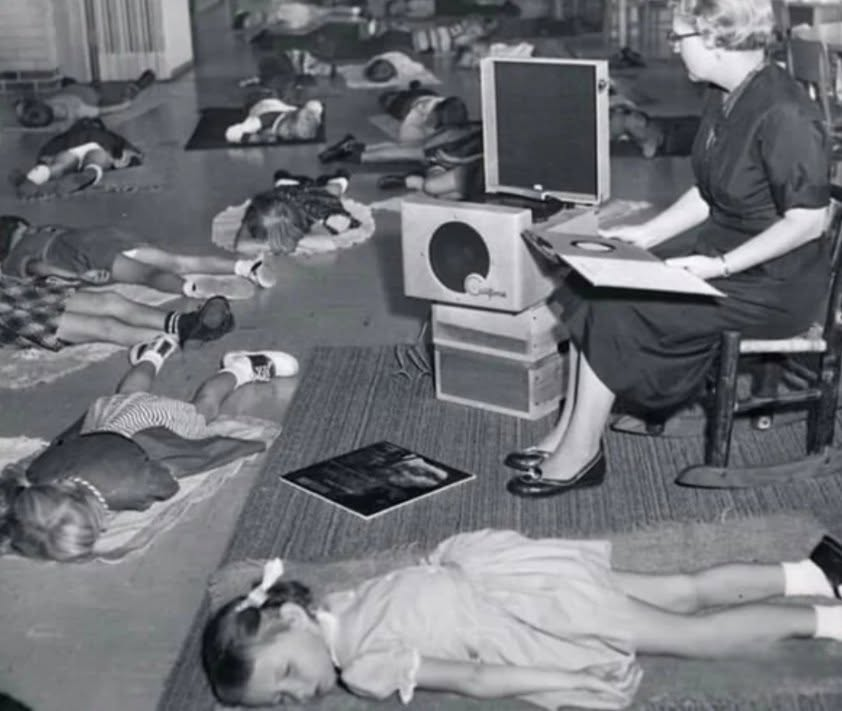
A record player sat in the corner, and with the gentle crackle of a needle finding its place, a slow melody filled the classroom.
Then came the words every child knew.
“Naptime.”
For children growing up in the 1950s, 1960s, and early 1970s, this simple word represented one of the most familiar parts of the kindergarten experience.
Before the era of tablets, interactive whiteboards, and tightly scheduled academic lessons, many classrooms had a daily pause built into the rhythm of childhood.
The mats came out.
The blankets appeared.
Little shoes were pushed aside.
Twenty small children stretched out across the classroom floor, each finding a comfortable position on striped sleeping mats or colorful rugs.
Some hugged blankets worn soft from years of use. Some held stuffed animals brought from home.
Others simply closed their eyes and listened to the quiet sounds around them.
And for a brief moment, an entire classroom learned how to stop.
The teacher moved slowly between the rows of resting children. Her footsteps were gentle.
Her voice became softer. She checked blankets, adjusted pillows, and made sure every child felt safe.
To many adults who experienced it, kindergarten naptime remains one of the strongest memories of early childhood.
Not because it was exciting.
Not because anything dramatic happened.
But because it represented something rare.
A moment when nobody had to perform.
Nobody had to compete.
Nobody had to rush.
Children were simply allowed to exist.
Looking back decades later, many people remember those quiet afternoons as more than a school routine. They remember them as a lesson they did not realize they were learning at the time.
Rest mattered.
Silence mattered.
Taking a pause was not laziness.
It was part of growing.
Why Naptime Was Considered Essential in Early Education
The idea behind kindergarten naptime was not simply to give teachers a break or create a peaceful afternoon.
Educators believed rest was a necessary part of childhood development.
In the middle of the twentieth century, early childhood education was strongly influenced by the idea that young children learned through balance.
A day was not supposed to consist only of instruction. It was supposed to include movement, creativity, social interaction, imagination, and quiet reflection.
Kindergarten was viewed as a bridge between home and formal schooling.
It was a place where children learned how to share, cooperate, listen, express themselves, and become comfortable in a classroom environment.
Academic achievement mattered, but it was not the only goal.
Teachers understood something that parents and researchers continue to discuss today: young children have different physical and emotional needs than older students.
A five-year-old is still developing the ability to regulate emotions, maintain attention, and manage stimulation.
A classroom filled with new experiences can be overwhelming.
The sounds.
The movement.
The expectations.
The constant interaction with other children.
For many children, naptime provided a reset.
It allowed their minds and bodies to recover from the intensity of the morning.
Teachers often described this quiet period as an important transition. After rest, children returned to afternoon activities with renewed energy. They could focus better. They could participate more calmly. They could handle frustration more easily.
The classroom was not viewed as a factory producing academic results.
It was viewed as a place where children developed as whole human beings.
A child who spent twenty minutes resting was not considered a child falling behind.
That child was considered a child being cared for.
The Teachers Who Created a Culture of Calm
For many former kindergarten students, the most unforgettable part of naptime was not the sleeping.
It was the teacher.
The kindergarten teacher became the guardian of those quiet minutes.
She knew which child needed a little extra reassurance.
She knew which child missed home.
She knew which child would fall asleep instantly and which child would stare at the ceiling for the entire rest period.
Some children loved naptime.
They were exhausted after hours of playing, learning, and adjusting to the unfamiliar world of school. The moment their heads touched their blankets, they were asleep.
Others struggled.
They were the children who could never quite relax.
They looked around the room.
They watched shadows move across the ceiling.
They counted patterns on tiles.
They listened to the breathing of classmates nearby.
But even those children learned something important.
They learned that quiet had value.
They learned patience.
They learned that not every moment needed to be filled with activity.
A skilled teacher understood that naptime was not only about sleep.
It was about creating emotional safety.
The dim lights.
The soft music.
The predictable routine.
All of these things helped children understand that the classroom was a place where they could feel secure.
In a world that often moved too quickly, kindergarten offered a protected space.
The teacher was not simply teaching letters and numbers.
She was teaching children how to exist peacefully with themselves and others.
The Disappearance of the Kindergarten Nap
By the 1970s and 1980s, American education began changing.
The purpose of kindergarten slowly shifted.
For much of the twentieth century, kindergarten had emphasized social development, creativity, and learning through play. But as educational expectations increased, classrooms began placing greater emphasis on academic preparation.
Parents worried about whether their children were ready for first grade.
Schools focused more attention on reading skills, mathematics, and measurable achievement.
The phrase “kindergarten readiness” became increasingly common.
The kindergarten classroom began to look different.
The play areas became smaller.
The academic materials became more prominent.
The daily schedule became more structured.
And slowly, naptime began disappearing.
The old sleeping mats were folded away.
The blankets stopped coming to school.
The record players that once filled classrooms with calming music were replaced by newer technology.
The quiet hour became viewed by some as lost instructional time.
Every minute became valuable.
Every activity needed a purpose.
Every part of the school day needed to produce visible results.
The change did not happen overnight.
Different schools and communities made different choices.
Some continued rest periods, especially for younger children or full-day programs.
But across many public kindergarten classrooms, the traditional daily nap became much less common.
The classroom that once paused in the middle of the day became a classroom that kept moving.
A New Childhood Rhythm in a Faster World
Today’s kindergarten experience is very different from what many older generations remember.
Many five-year-olds spend their days following schedules filled with reading groups, mathematics activities, technology lessons, classroom projects, and structured learning exercises.
The modern kindergarten student may spend more time practicing academic skills than previous generations did at the same age.
For many educators, this change reflects the demands of a changing world.
Schools are expected to prepare children for increasingly complex academic environments.
Parents want their children to have every possible opportunity.
Communities want students to succeed.
But the disappearance of naptime has also raised questions about childhood itself.
What happens when young children are expected to function like older students?
What happens when every minute is scheduled?
What happens when children have fewer moments for imagination, boredom, and quiet?
Child development specialists have long emphasized the importance of play and rest in early childhood. While the exact structure of kindergarten varies widely, many experts continue to argue that young children benefit from opportunities to recover, explore, and engage in less structured activities.
The debate is not simply about whether every kindergarten classroom should bring back traditional naps.
The deeper question is about balance.
Can children learn important academic skills while still having time to be children?
Can schools create environments where achievement and emotional well-being exist together?
Those questions continue to shape conversations about early education.
The Memory of the Classroom That Allowed Children to Slow Down
For those who experienced kindergarten naptime, the memory often remains surprisingly vivid.
People remember the small details.
The texture of the sleeping mats.
The sound of the classroom becoming quiet.
The smell of blankets brought from home.
The soft music playing in the background.
The sunlight moving slowly across the floor.
These memories survive because they represent something deeper than a school activity.
They represent a slower version of childhood.
A time when children were not constantly connected to screens.
A time before every moment was measured.
A time when boredom was not considered a problem to solve.
For many adults, remembering kindergarten naptime brings back a feeling rather than just an image.
A feeling of safety.
A feeling of being cared for.
A feeling that someone had created a space where it was acceptable to simply rest.
Modern life often celebrates productivity.
People are praised for working harder, achieving more, and staying constantly active.
But childhood memories like naptime remind us that rest has always been part of human development.
Rest is not the opposite of progress.
Sometimes rest makes progress possible.
The Lesson Kindergarten Naptime Left Behind
The disappearance of kindergarten naptime is not only a story about education.
It is a story about how society’s values change over time.
The classrooms of the 1950s and 1960s reflected one understanding of childhood.
The classrooms of today reflect another.
Neither era was perfect.
Every generation faces different challenges.
But the memory of those quiet kindergarten afternoons offers a lesson worth considering.
Children need moments of peace.
They need opportunities to slow down.
They need time to imagine, recover, and simply breathe.
The greatest lessons of childhood are not always found in textbooks.
Sometimes they are found in quiet moments.
A teacher lowering the lights.
A child pulling a blanket closer.
A classroom becoming peaceful for twenty small children.
Those moments taught something powerful.
That human beings are not machines.
That growth requires balance.
That rest is not wasted time.
It is part of becoming who we are.
Perhaps the greatest lesson from kindergarten naptime is not that every classroom must return to the past.
It is that every generation should remember something simple:
Children are still children.
They need knowledge.
They need guidance.
They need challenges.
But they also need kindness.
They need play.
And sometimes, in the middle of a busy day, they need permission to close their eyes, become quiet, and rest.
Because long before adults learned how difficult it was to slow down, kindergarten teachers were already teaching the importance of doing exactly that.
A lesson written not on a blackboard.
But on a classroom floor, beneath dim lights, beside rows of sleeping children.
A lesson that perhaps the world still needs today.