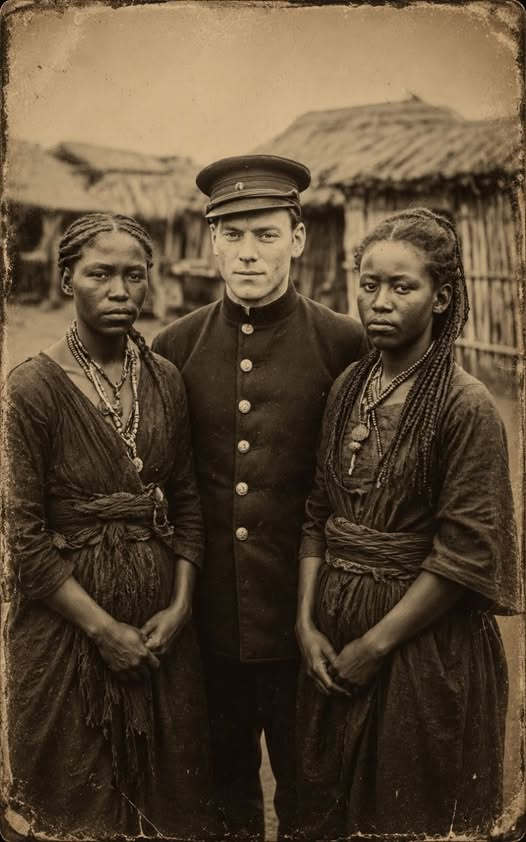
For decades, thousands of people carried a painful question that had no answer.
Why were they taken?
Why were they separated from the women who gave birth to them?
And why did governments that claimed to be protecting them become the very force that destroyed their childhoods?
Their names were often lost.
Their stories were often ignored.
But they were real people who lived through one of the most painful chapters of Belgium’s colonial history.
They were the métis children of Belgian Congo.
Born between European fathers and African mothers during the colonial era, these children grew up trapped between two worlds. They were often rejected by the European society that created them, yet sometimes treated as outsiders within the African communities where their mothers raised them.
For many, childhood was shaped not by belonging, but by confusion.
They carried the appearance of two cultures while being accepted fully by neither.
And in the years before and after Congo’s independence, thousands experienced separation from their families through colonial policies that claimed to offer protection but often caused lifelong trauma.
This is the story of the forgotten children of Belgian Congo.
A story about identity.
A story about power.
And a story about people who spent decades searching for the families they lost.
A Colony Built On Contradictions
Belgian Congo existed as a colonial territory from 1908 until independence in 1960.
During those decades, Belgium built a powerful economic system based on the extraction of Congo’s enormous natural resources.
Rubber.
Copper.
Diamonds.
Timber.
The colony became a source of wealth for Belgium, while millions of Congolese people lived under a system controlled by European authorities.
Colonial society was built around strict racial divisions.
European settlers lived in separate neighborhoods with better housing, electricity, healthcare, and infrastructure.
African communities were governed by different rules and had far fewer opportunities.
The colonial administration promoted the idea that Europeans and Africans belonged to separate social worlds.
Officially, relationships between European men and African women were discouraged or restricted.
But reality was very different.
Thousands of European men arrived in Congo without their wives or families. They worked as administrators, soldiers, engineers, businessmen, and officials.
Many formed relationships with African women.
Some relationships were voluntary.
Others existed within a powerful imbalance created by colonial rule, where European men controlled employment, money, and social status.
Many of these relationships resulted in children.
Children who would later become known as métis.

Children Between Two Worlds
The word métis referred to people of mixed European and African ancestry.
In theory, these children represented a bridge between cultures.
In reality, they often became symbols of a contradiction that colonial authorities did not want to acknowledge.
They were evidence that the racial boundaries promoted by the colonial system were not as absolute as officials claimed.
Many European fathers refused to officially recognize their children.
Some provided financial support.
Some disappeared completely.
Others returned to Europe, leaving behind children who knew little about their fathers beyond a name, a photograph, or a story told by their mothers.
The children grew up carrying questions.
Who was my father?
Why did he leave?
Why was I treated differently?
Why did some people see me as neither fully European nor fully African?
For many métis children, identity became something they had to search for rather than something they inherited naturally.
The Creation of Colonial “Protection” Programs
After World War II, colonial authorities became increasingly concerned about the growing métis population.
Instead of addressing the inequalities that had created these circumstances, officials focused on managing the children themselves.
In the late 1940s, Belgian authorities created organizations intended to oversee the education and upbringing of métis children.
The stated goal was protection.
Officials claimed these programs would provide children with better education, healthcare, and opportunities.
But many families experienced something very different.
Children were separated from their mothers.
Some were placed in religious institutions.
Some were sent to special schools far away from their villages.
Many mothers had little power to challenge these decisions.
Under colonial rule, European authorities controlled the legal system, education system, and social institutions.
A Congolese mother who wanted to keep her child often had almost no ability to fight against government decisions.
For many families, separation happened suddenly.
A child who left home for “school” might never return.
The Story Of Monique
Among the thousands of children affected were girls and boys like Monique.
Her story represents the experience of many métis children during this period.
She was born in the 1940s in Belgian Congo.
Her mother raised her in a small community where everyone knew her family.
From a young age, Monique understood she was different.
People noticed her appearance.
Children asked questions.
Adults whispered.
She knew she had a father she had never met, a European man whose identity remained distant and complicated.
Her mother tried to protect her.
She taught her the language of their community.
She taught her traditions.
She reminded her daughter that she belonged.
But outside forces constantly challenged that sense of belonging.
Colonial society viewed mixed-race children through categories created by officials.
They were not simply children.
They were classified.
Measured.
Recorded.
Managed.
Their identities were often reduced to government paperwork.
The Pain Of Separation
For many mothers, losing a child was the greatest tragedy imaginable.
Some were told separation was temporary.
Some believed their children would receive education and return home.
Some were pressured into agreeing because refusing could bring consequences.
Years later, many métis adults described the emotional wounds left by these experiences.
They remembered unfamiliar buildings.
Strangers speaking different languages.
The confusion of being removed from everything familiar.
The loneliness of growing up without their mothers.
Some children spent years believing their parents had abandoned them.
Only later did they discover that their families had been searching for them.
The End Of Colonial Rule
In 1960, Congo gained independence from Belgium.
The transition was chaotic.
Many Europeans left quickly.
Political instability increased.
For métis children who had been separated from their families, this created even more uncertainty.
Some institutions closed.
Records disappeared.
Families became harder to locate.
Children who had already lost their connection to their mothers and communities faced another loss: the disappearance of the system that had controlled their lives.
Many were left without clear information about their origins.
Some searched for decades.
The Long Search For Identity
The story of the métis children did not end when colonial rule ended.
For many survivors, the search continued throughout their lives.
They looked for birth records.
They searched archives.
They contacted organizations.
They traveled back to villages they had not seen since childhood.
Some found their families.
Others found only names on documents.
Many discovered painful truths about a past that had been hidden from them.
Their experiences raised difficult questions.
Who has the right to decide what is best for a child?
What happens when governments separate families in the name of protection?
How long can injustice remain hidden before survivors demand recognition?
A History That Must Be Remembered
The story of Belgian Congo’s métis children is not only about colonial policies.
It is about individual lives.
Every child taken away had a name.
A mother.
A childhood.
A future that was changed forever.
Behind every statistic was a personal story.
A mother waiting.
A child wondering.
A family searching.
For many years, these stories received little attention.
But survivors and their descendants continued speaking.
They preserved memories.
They shared documents.
They demanded that their experiences become part of history.
Because remembering is not only about the past.
It is about recognizing the people who lived through it.
The Children Who Refused To Be Forgotten
The métis children of Belgian Congo grew up carrying complicated identities.
They were shaped by multiple cultures.
They survived systems that tried to define them.
And many spent their lives rebuilding the connections that had been taken away.
Their stories reveal one of the deepest lessons of history:
A person’s identity cannot be controlled by a government, a document, or a category.
It comes from memory.
From family.
From the people who love them.
The children who were once separated from their homes are no longer silent figures in forgotten records.
They are survivors.
They are parents.
They are grandparents.
And they are living reminders that even after decades of separation, the human desire to know where we come from never disappears.