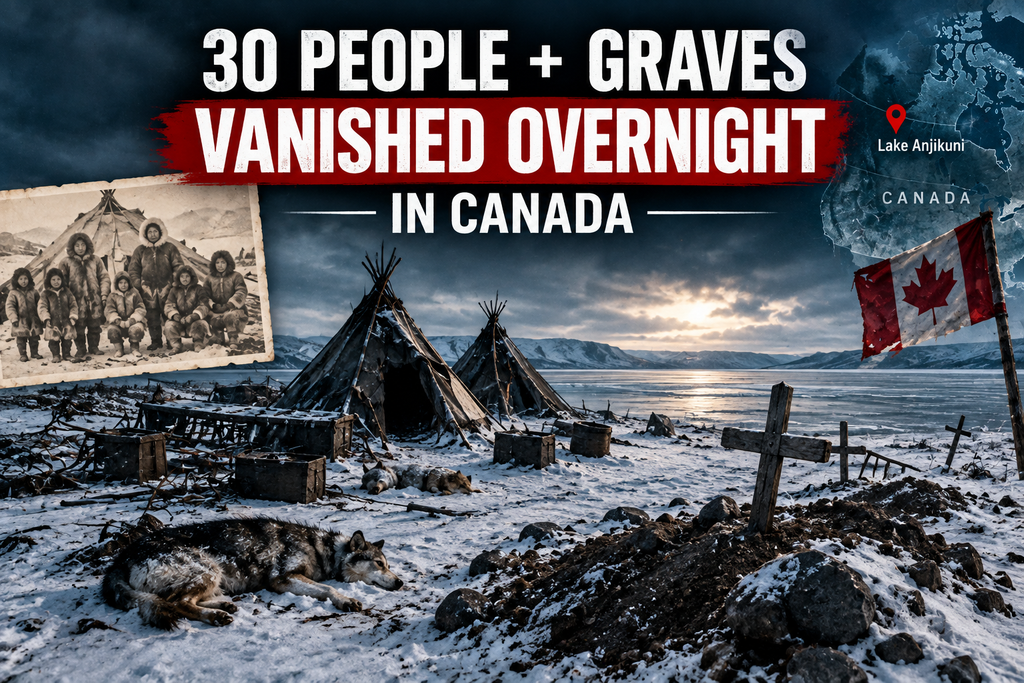
Deep in the Canadian Arctic, one of the strangest disappearance stories of the 20th century began with an allegedly deserted Inuit camp near Lake Anjikuni. According to the legend, roughly 25 to 30 people had disappeared, leaving behind an eerily empty settlement and even graves that were supposedly found disturbed. But the deeper investigators looked, the more complicated the story became.
The Mysterious Lake Anjikuni Story
The story dates back to 1930, when newspapers reported that a trapper named Joe Labelle had supposedly discovered an abandoned Inuit settlement near Lake Anjikuni in what was then the Northwest Territories.
The account described a scene that sounded almost impossible.
The people were reportedly gone, while belongings and supplies were allegedly left behind. Later versions of the story added even more disturbing details, including abandoned food, weapons, dead sled dogs, and graves that had supposedly been opened.
The mystery quickly became one of Canada’s most famous unexplained stories.
But there was a major problem: the evidence for the disappearance was extremely weak.
Where Did the Story Come From?
The earliest known newspaper version appeared in November 1930. It described an empty camp and claimed that approximately 25 people had disappeared.
Over the years, however, the story changed.
Books and magazines repeated the account and added increasingly dramatic details. Some versions claimed that dozens of people had vanished overnight. Others dramatically increased the number of missing people, sometimes suggesting that hundreds or even thousands had disappeared.
The mysterious graves also became a major part of the popular version of the story.
With every retelling, the legend became more dramatic.
The RCMP Investigated the Claims
The Royal Canadian Mounted Police eventually addressed the story directly.
According to the RCMP’s historical account, there is no evidence supporting the supposed mass disappearance. The police also noted that officers who patrolled the region at the time recorded no unusual event involving a vanished village. Local trappers and missionaries likewise did not report anything matching the legend.
That makes the story very different from how it is often presented online.
Rather than being a confirmed case of 30 people mysteriously disappearing, the evidence points toward a sensational story that was repeated and expanded over many years.
What About the Empty Graves?
The grave detail is one of the most disturbing parts of the legend.
In popular retellings, graves were supposedly discovered open and empty, making the disappearance seem even more mysterious.
However, the evidence for this part of the story is also questionable.
The RCMP says the overall Anjikuni disappearance story is not supported by evidence. That means the dramatic claim about graves should not be treated as an established historical fact.
This distinction is important because an extraordinary story can become more convincing simply through repetition.
A detail appearing in dozens of articles does not necessarily mean that independent evidence exists for it.
Why Did the Story Become So Famous?
The Lake Anjikuni story had all the ingredients of a classic mystery.
A remote Arctic location.
An apparently abandoned settlement.
People who were supposedly nowhere to be found.
Unexplained graves.
Dead dogs.
And no obvious explanation.
Those details made the story perfect for books about unexplained events, strange disappearances and supernatural mysteries.
According to the RCMP, the story became popular through repeated publication and later appearances in books and magazines. The police specifically identify American author Frank Edwards as an important figure in the story’s later popularization.
A Mystery That Became a Legend
The most interesting part of the Anjikuni story may not be the alleged disappearance itself.
It may be how a questionable newspaper story developed into a famous mystery.
The original report was already dramatic, but later versions added details and sometimes changed the number of people supposedly involved. Over decades, these additions were repeated as though they were part of the original event.
Eventually, many readers encountered the story without knowing that its historical foundation was disputed.
This is how legends can develop.
A dramatic newspaper report becomes a magazine story. The magazine story becomes a book chapter. The book is later cited by another writer. Eventually, the story appears to have multiple sources even though many accounts can be traced back to earlier versions of the same tale.
Was Anyone Really Missing?
There is no reliable evidence establishing that approximately 30 people from a village near Lake Anjikuni mysteriously disappeared overnight in the way the legend claims.
The RCMP’s own historical page explicitly describes the story as untrue and says there is no evidence supporting it.
That doesn’t mean every detail connected with the region was invented. It means the specific claim of an entire Inuit village mysteriously disappearing has not been established by reliable historical records.
And that distinction matters.
The Real Lesson Behind the Mystery
The Lake Anjikuni story remains fascinating because it shows how easily an unexplained newspaper report can become something much larger.
The Canadian Arctic of the early 20th century was remote, difficult to travel through and poorly connected to the outside world. Stories from isolated regions could be difficult for readers elsewhere to verify.
A dramatic account could therefore spread long before anyone had the opportunity to examine every detail.
Today, the story continues to circulate online as a mysterious disappearance, often without mentioning the evidence problems identified by the RCMP.
The phrase “30 people vanished overnight” is certainly attention-grabbing.
But the historical record tells a more complicated story.
The Mystery Remains — But Not in the Way You Might Think
The alleged disappearance near Lake Anjikuni is often presented as one of Canada’s greatest unsolved mysteries.
Yet according to the RCMP, it is better understood as an enduring urban legend rather than a verified mass disappearance.
The story survives because it is unforgettable: an empty Arctic camp, missing people, mysterious graves and a question with no satisfying answer.
But sometimes the biggest mystery is not what happened to the missing people.
It is how a story without reliable evidence became one of the world’s most famous disappearance legends.