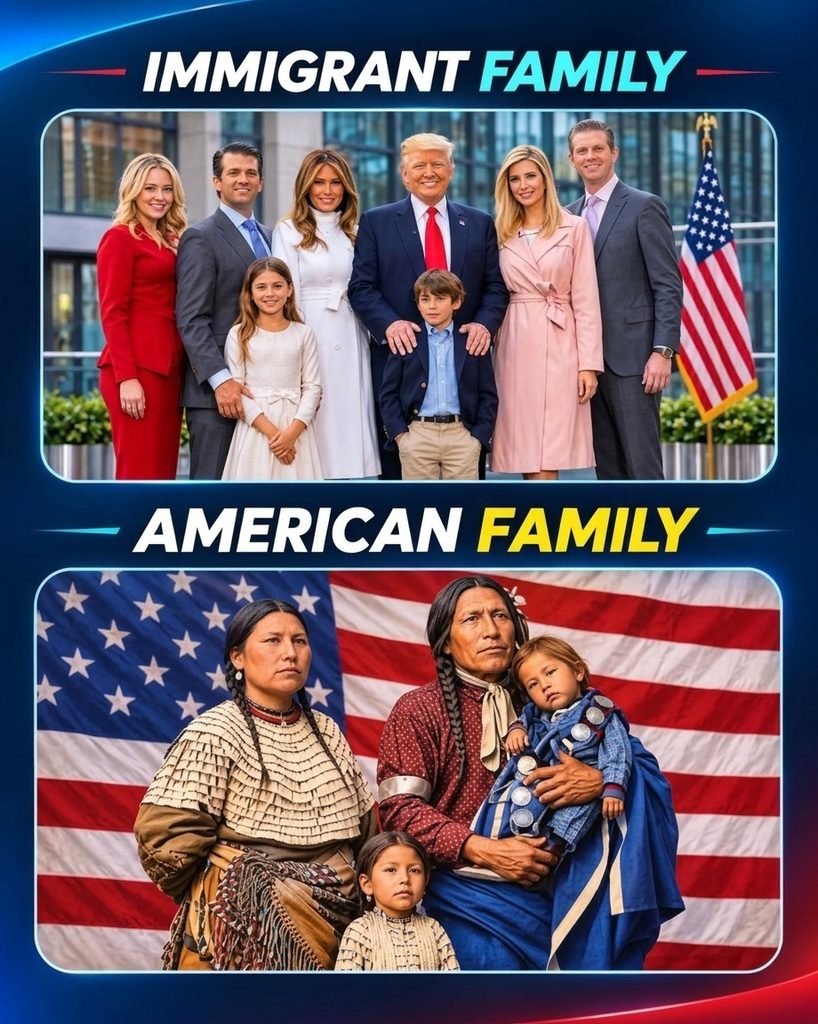
IMMIGRANT FAMILY vs. AMERICAN FAMILY: The Irony Behind America’s Immigration Debate 🇺🇸
The debate over immigration in America has always been complicated, but sometimes history reveals an irony that is difficult to ignore. A closer look at Donald Trump’s family background raises an important question about immigration, identity, and who truly belongs in America.
Donald Trump has built much of his political identity around strict immigration policies, border security, and promises to control who enters the United States. Yet his own family history is closely connected to immigration. His wife, Melania Trump, was born in Slovenia and later immigrated to the United States. His mother, Mary Anne MacLeod, was born in Scotland, while his paternal grandparents came from Germany.
This means that immigration is not separate from the Trump family’s story. Like many American families, their history includes people who crossed borders and built new lives in a different country.
But there is another side of America’s history that deserves equal attention.
Long before the United States became an independent nation, Native American communities were already living across this land. They had established their own societies, cultures, languages, traditions, and systems of government thousands of years before European settlers arrived. Their connection to this land goes back generations beyond the creation of the modern American nation.
Today, the contrast raises an important question: What does it really mean to be American?
Is being American defined by how many generations a family has lived in the country? Is it determined by legal immigration, citizenship, or birthplace? Or should the history and contributions of Indigenous communities be recognized as an essential part of America’s identity?
The United States is a country shaped by immigration, but its history did not begin with European arrival. Native Americans are not simply another chapter in the story of America; they are part of its earliest history.
Immigration policies, border security, and national identity are legitimate subjects of political debate. However, those conversations should also acknowledge the historical experiences of the people whose ancestors were already here long before modern borders existed.
Perhaps the most important lesson is that America’s identity cannot be understood through one family’s history or one political movement. It is a story shaped by Indigenous peoples, generations of immigrants, and communities from around the world.
Before judging who belongs in America, shouldn’t we first understand the full history of how America became what it is today?