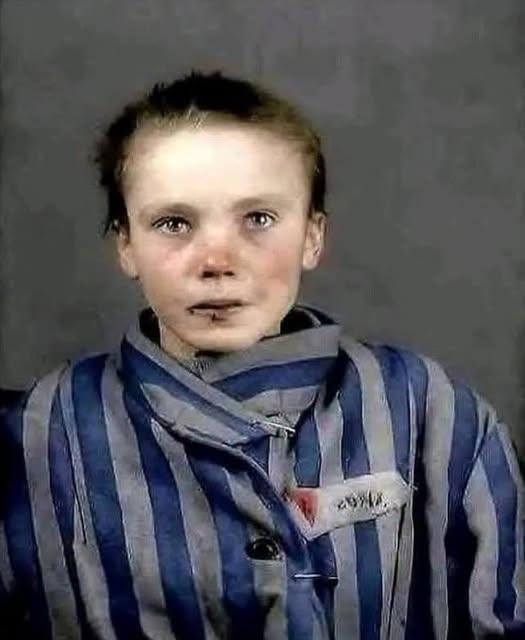
She was fourteen years old, and she had been in Auschwitz for only a few days when a prisoner named Wilhelm Brasse pointed his camera at her.
She did not understand a word of German. She had just been struck in the face. And then she looked straight into the lens — and into history.
The Face in the Photograph
Look at her face first, before you read anything else. She is fourteen. Her dark hair is parted in the middle and cut short.
She wears the striped uniform of the camp, and on it sits a red triangle marked with the letter P — the mark the Germans gave to Polish political prisoners.
Her eyes are wide and fixed on the camera. And on her lower lip, if you look closely, you can see the cut.
The photograph was taken in late 1942 or early 1943, days after she arrived at Auschwitz.
It was not a portrait taken with love. It was an identity picture, ordered by the camp, one of tens of thousands taken to file prisoners away like objects.
The man behind the camera was himself a prisoner, and he took three photographs of her, as the camp’s procedure required — the front view, the side view, and one more angle — so that the file would hold her whole face.
He could not have known that one of those three frames would travel further than any photograph he ever took, or that eighty years later, millions of strangers would know this girl’s face and speak her name.
The original black-and-white photograph is kept at the Auschwitz-Birkenau State Museum in Oświęcim, Poland, where it hangs in the Block 6 exhibition, “The Life of the Prisoners,” among the faces of thousands of others.
Her likeness is also featured on the museum’s official website and in its published albums and catalogues.
Most of those faces have no names attached to them in the public mind. Hers does. Her name was Czesława Kwoka, and she was prisoner number 26947.
There is something about this photograph that stops people. It is not the horror of the camp — the picture shows no barbed wire, no guards, no smoke. It is the ordinariness of the girl. She looks like a schoolgirl.
She looks like somebody’s daughter. She looks, in fact, like a child who has just been hurt and does not understand why, because that is exactly what she was.
The camera caught her at the worst moment of a short life, and because it did, she has never been allowed to disappear the way the camp intended her to.
The photograph has since been reproduced in books, exhibitions and classrooms around the world.
In the colorized version, two details become impossible to miss: the red triangle on her uniform, and the dark dried blood on her lower lip, still there from the blow she took moments before the shutter opened.
She never spoke a word to the camera — and yet her face has spoken to millions.
A Village Called Wólka Złojecka
Czesława Kwoka was born on 15 August 1928 in Wólka Złojecka, a small village in the Zamość region of southeastern Poland.
She was a Polish Catholic girl, the daughter of Katarzyna Kwoka. Nothing about her life before the war survives in the records — no school report, no diary, no letters.
She was an ordinary child in an ordinary village, and the war found her there all the same.
In November 1942, Heinrich Himmler ordered the emptying of the Zamość region.
It was part of a plan the Nazis called Generalplan Ost — the General Plan for the East — which meant clearing Slavic families off their land to make room for German settlers, a policy they called Lebensraum, living space.
The operation began on the night of 27 November 1942. Families were driven out of their homes at gunpoint. In all, some 116,000 Polish men, women and children were expelled from the region, among them around 30,000 children. Historians estimate that more than 10,000 of those children died.
The expelled families were herded into a transit camp at Zamość, where SS officers sorted them the way farmers sort livestock. Children were pulled away from their parents and put in separate barracks. Children with light hair and light eyes were taken away to be raised as Germans — more than 4,400 of them were Germanized and never saw their families again. The rest were sent to forced labour in Germany, or to concentration camps.
The plan was even bigger than what happened. Himmler intended to clear 696 villages and settle 98,000 Germans in the region; a small “test” expulsion ran from 6 to 25 November 1942 before the main operation began. In the end, about 41,000 people from 116 villages were expelled by March 1943 — less than a third of the 140,000 the planners had intended — partly because the Polish Home Army got hold of the expulsion map in late December 1942 and warned the villages. But tens of thousands of children had already been swept into the machine. As many as 13,000 children passed through a camp for children in Łódź. As many as 15,000 people from the Zamość region ended up in the Majdanek camp. And 1,301 of them were sent to Auschwitz.
Czesława and her mother were among those sent to Auschwitz. Their train left Zamość on 10 December 1942 and reached the camp on the night of 12 December. The first transport from the region carried 640 people; Czesława arrived with a group of 318 women. On 13 December 1942, mother and daughter were registered as prisoners. Katarzyna became number 26946. Czesława, fourteen years old, became number 26947.
Her crime was being Polish, Catholic, and fourteen years old.
But the photograph was only half the story. The other half belonged to the man holding the camera — and he never forgot her face.
The Man Behind the Camera
Wilhelm Brasse was born on 3 December 1917 in Żywiec, in southern Poland, to an Austrian father and a Polish mother. Before the war he trained as a portrait photographer in his aunt’s studio in Katowice. When the Germans occupied Poland, he refused to join the German army and refused to declare himself German. For that, in 1940, he was sent to Auschwitz. He became prisoner number 3444.
The camp had a photography unit, the Erkennungsdienst — the identification service — and because Brasse knew cameras, the SS put him to work in it. Over the next five years he was ordered to take an estimated 40,000 to 50,000 identity pictures of prisoners. He was also forced to photograph the camp’s medical experiments. He saw everything, and he could say nothing. To refuse an order was to die.
He remembered Czesława. Decades later, he told a BBC correspondent what had happened in the room that day. “She was so young and so terrified,” he said. The girl did not understand why she was there, and she could not understand what was being said to her, because the orders were shouted in German. A woman Kapo — a prisoner overseer — took a stick and beat her about the face. “Before the photograph was taken, the girl dried her tears and the blood from the cut on her lip.” And then Brasse said the words that have stayed with everyone who has read them: “I felt as if I was being hit myself but I couldn’t interfere. It would have been fatal for me.”
He told her story again in The Portraitist, a documentary film about his life made in 2005. He held up her photograph and spoke about the girl in it as if no time had passed at all. The film, directed by Irek Dobrowolski, ran for 52 minutes and was first shown on Polish television on 1 January 2006. Some of Brasse’s photographs are on display not only in the Auschwitz museum but also at Yad Vashem, Israel’s memorial to the victims of the Holocaust. His book of photographs, Wilhelm Brasse: Photographer. 3444. Auschwitz. 1940–1945, was published in 2012, the year he died. Among the photographs he was forced to take was what is believed to be the only known surviving image of the medical experiments carried out in the camp — a picture he took because refusing would have meant his own death. Shortly before his death, he told an interviewer: “I saw all those big eyes, terrified, staring at me. I could not go on. These are things you can never forget.” Wilhelm Brasse died on 23 October 2012, in his hometown of Żywiec, at the age of 94. He had spent his last years doing the one thing the camp could not stop him from doing: telling the world what he had seen through that lens.
He was ordered to take her picture for the camp’s records. Instead, he saved her from being forgotten.
Three Months
Czesława Kwoka lived for three months in Auschwitz. That is almost everything the records can tell us about her time there. No diary survives. No letter home survives. No fellow prisoner left an account of her days. What we know about the camp in that winter is terrible enough on its own: the cold, the hunger, the roll calls that lasted for hours in the snow, the diseases that moved through the barracks faster than any rumour. A fourteen-year-old girl, taken from her village two weeks before Christmas, would have had almost nothing to protect her except her mother beside her.
Her mother died first. Katarzyna Kwoka — prisoner 26946 — died on 18 February 1943, two months after they arrived. Czesława was left alone in the camp at fourteen, in a place designed to make sure no one survived it for long. Less than a month later, on 12 March 1943, she died too.
The camp’s own records lie about how she died. Her death certificate lists wasting sickness and intestinal catarrh — the kind of tidy, medical-sounding cause the camp clerks wrote down for thousands of prisoners they had murdered. The true circumstances of her death were not recorded. What historians believe, and what the evidence points to, is that she was most likely killed with an injection of phenol into her heart — the method the camp used on children from the Zamość transports, and on newborn babies born in the camp. The Museum of Polish Children records that the children of Zamość “died of exhaustion, in gas chambers, or were killed with injections of phenol into their hearts.” We say “most likely” because honesty demands it: the people who killed her did not leave a true record, and we will not invent one for them.
She was not the only one. Three transports carried people from the Zamość transit camp to Auschwitz — arriving on 13 December 1942, 16 December 1942, and 5 February 1943. In all, 1,301 people were registered, including at least 162 children, the youngest of them eight years old. At least 1,010 of the 1,301 lost their lives — more than three out of every four. Of the roughly 160 children in those transports, more than 100 perished. Several dozen teenage boys from the region were murdered in an organized action of lethal injections. Of the boys, only seven survived. Women who gave birth in the camp were murdered together with their newborn babies by phenol injection, a practice that continued until May 1943. Czesława Kwoka was one face among all of them. She was also, in a way none of them could have foreseen, the face the world would remember.
The camp wrote a lie on her death certificate. The truth is written in her face.
One child. But the number she belonged to is almost impossible to hold in your mind.
One of 232,000
The Auschwitz-Birkenau State Museum estimates that at least 1.3 million people were deported to Auschwitz between 1940 and 1945, and that about 1.1 million of them died there. Among the deported were around 232,000 children and young people: about 216,000 Jewish children, 11,000 Roma children, at least 3,000 Polish children, and more than 1,000 children from Belarus, Ukraine and other countries. Czesława was one of the 3,000 Polish children.
Only about 23,000 of those 232,000 children were ever registered as prisoners and given a number. The rest — the vast majority, most of them Jewish children — were murdered in the gas chambers immediately after arrival, without ever being registered at all. They left no number behind. They left no photograph behind. They left nothing the camp bothered to record.
Slightly more than 700 children were still alive in the camp when Soviet soldiers liberated Auschwitz on 27 January 1945. At least 700 children had been born inside the camp during its years of operation; at least 60 of them lived to see liberation. The museum’s researchers put it plainly: the fate of child prisoners was essentially no different from that of adult prisoners. There was no mercy for the young. When the museum marked the 76th anniversary of the liberation in January 2021, it chose the fate of children as its theme, and its director, Piotr Cywiński, said the number out loud: over 200,000 children were murdered in Auschwitz. The commemoration was held online, and the director laid a wreath at the Death Wall in Auschwitz I and placed a candle at the monument in Birkenau. The museum’s historian Helena Kubica, who worked in its Research Center for more than forty years, wrote the online lesson “Children in KL Auschwitz” so that the children’s stories would be taught, not just counted.
In the museum’s collection today there are some 8,000 pairs of children’s shoes. Small shoes. Worn shoes. Shoes with the laces still in them. In 2022, the museum, the Auschwitz-Birkenau Foundation and the International March of the Living signed an agreement to conserve them, because leather crumbles and memory needs something to hold on to. Each pair belonged to a child who arrived at Auschwitz with shoes on their feet. Czesława Kwoka arrived in winter, in December, in the snow. She would have worn shoes too. In October 2025, the museum held a webinar on the fate of children in the camp, with lectures on children born in Auschwitz and on the camp as seen through children’s eyes — and on their difficult return to life after the war. The children who survived had to learn how to live again, in a world that had murdered their families.
We cannot hold 232,000 children in our minds. But we can hold one girl’s face — and that is where remembering starts.
The Face That Would Not Disappear
Czesława Kwoka’s photograph never went away. It hangs in the museum’s Block 6 exhibition, where visitors from all over the world stop in front of it. In 2005, Wilhelm Brasse held it up on camera in The Portraitist and told the world about the girl in it. In 2007, the poet Theresa Edwards and the artist Lori Schreiner made a collaborative work from Brasse’s three photographs of her — Painting Czesława Kwoka — which won a literary award in the United States. She has become the symbol of the Children of the Zamość Region, the 30,000 children torn from their homes in the winter of 1942.
Then, in 2016, a young Brazilian artist named Marina Amaral did something that carried Czesława’s face further than ever before. Amaral, born in 1994, had begun colorizing old black-and-white photographs in 2015, working by hand in Photoshop, researching the true colours of every uniform and every object. For Holocaust Remembrance Day in 2016, she released her colorized version of Czesława’s portrait on her blog. Two years later, in 2018, she colorized the portrait again as part of the museum’s own Faces of Auschwitz project, which restored twenty-one registration photographs in colour. She has called Czesława’s portrait her favourite of all the photographs she has ever colorized.
In colour, the girl stops looking like history and starts looking like somebody you know. The striped uniform turns blue-grey. The triangle turns red. The cut on her lip turns dark. Some people say colour brings her back to life — that it makes a stranger from 1942 feel like a real child, and that feeling is what makes us remember. Others say a photograph like this should never be altered, because the black-and-white original is a document, and documents should be left alone. Both sides are arguing about the same thing: how to keep faith with a fourteen-year-old girl who cannot speak for herself. The museum itself has embraced Amaral’s work, and her colorized portrait is now the version of Czesława most of the world has seen. Amaral went on to restore more than 200 historical photographs for the book The Colour of Time, written with the historian Dan Jones.
There is one more thing worth saying about the photograph’s journey, because it matters now more than ever. In recent years, researchers have found videos circulating online that use artificial intelligence to animate Czesława’s portrait — making her face move, making her blink and turn her head. She never made those movements. No camera ever recorded them. Amaral herself has written publicly against AI-created fake historical photographs. The real photograph — the one Brasse took, the one the museum keeps — is enough. It does not need to move to be alive. It has been alive for eighty years without moving at all.
The Nazis took her photograph to file her away. Instead, they gave the world a face it could never forget.
And that is why her photograph is still travelling — eighty years later, it found its way to your screen tonight.
Her Name Was Czesława Kwoka
Czesława Kwoka never got to tell her own story. She left no diary, no letters, no last words. What she left is a photograph, a prisoner number, and a man who remembered her face for seventy years and told the world about it. That turned out to be enough — enough for a museum exhibition, a film, a poem, a painting, and a portrait in colour that has now been seen by millions of people who never knew her name before tonight.
If you remember one thing from this story, remember her name. Say it once, out loud, the way her mother would have said it: Czesława Kwoka. She was fourteen. She was Polish, Catholic, and afraid, and she did not understand a word the guards were shouting at her. She died in March 1943, less than a month after her mother, in a camp that murdered more than 200,000 children. Behind her face stand 232,000 children, and behind each of them, a name we may never know. The camp kept 8,000 pairs of their shoes. It kept one photograph of her. And somehow, against everything the camp was built to do, the photograph outlived the camp.
What will you remember about her? Tell us in the comments — and if this story moved you, share it with someone who has never heard her name. That is how a fourteen-year-old girl from a small Polish village is still, eighty years later, refusing to disappear.