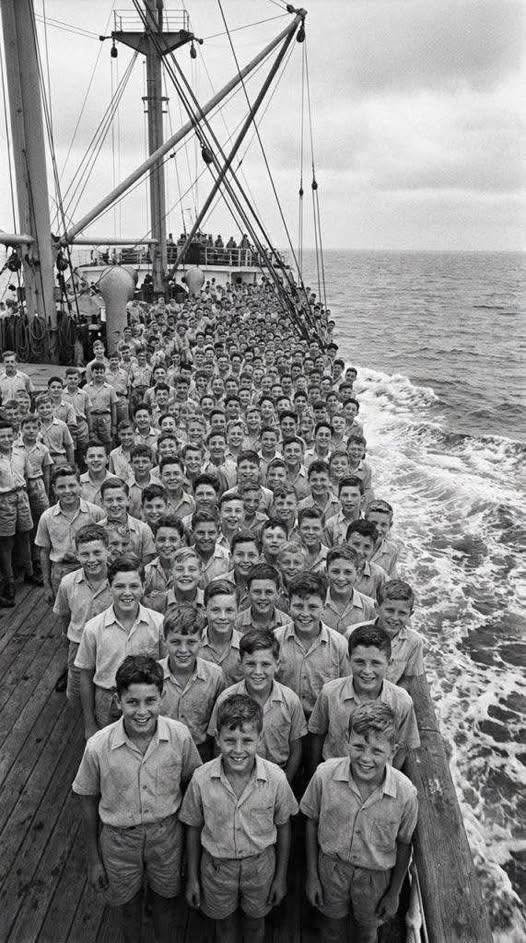
They had survived war, hunger, forced deportation, and the loss of their families. When hundreds of Polish children desperately needed a safe place to live, one Indian ruler opened his doors and changed their lives forever.
During World War II, thousands of Polish families experienced unimaginable suffering. Many were deported by Soviet authorities to remote parts of the Soviet Union, where hunger, disease, harsh weather, and exhausting labor claimed countless lives.
Among those who suffered were thousands of children.
Some lost their parents. Others became separated from their families. Many were left with little more than the clothes they were wearing and the hope of finding somewhere safe.
For a group of these young refugees, an extraordinary new chapter would begin thousands of miles from their homeland.
Their destination was India.
And the man who helped give them a home was an Indian maharaja whose compassion would never be forgotten.
A Childhood Stolen by War
Following the German and Soviet invasions of Poland in 1939, millions of Polish citizens experienced occupation, persecution, and displacement.
Many Polish people were deported deep into the Soviet Union. Children were among those forced to endure the terrible conditions of exile.
After an agreement between the Polish government-in-exile and the Soviet Union in 1941, efforts began to evacuate Polish citizens from Soviet territory.
As these refugees made their way out, some children arrived in Iran before continuing their journey toward safety.
But reaching a place outside the Soviet Union did not mean their suffering was over.
They needed food, medical treatment, education, and somewhere they could finally feel secure.
One Maharaja Decided to Help
The plight of the Polish children eventually reached Maharaja Jam Saheb Digvijaysinhji, ruler of the princely state of Nawanagar in western India.
Rather than turning away from their suffering, he offered land and accommodation for a settlement at Balachadi, near Jamnagar in present-day Gujarat.
His decision provided a place where hundreds of displaced Polish children could begin rebuilding their lives.
The first children arrived in July 1942.
The settlement eventually became home to hundreds of young refugees, with historical accounts recording different totals as more children arrived over time.
The maharaja’s gesture was especially meaningful because these children were strangers from a distant country, with no family connection to him.
Yet he welcomed them with compassion and treated their well-being as a personal responsibility.
“You Are No Longer Orphans”
One of the most memorable parts of this story is the welcome traditionally attributed to the maharaja.
He reassured the children that they would no longer have to think of themselves as orphans. They would be considered members of his wider family and part of Nawanagar.
He became affectionately known to many of them as Bapu, meaning father.
For children who had experienced separation, loss, and uncertainty, those words represented something they desperately needed: a sense of belonging.
They were no longer simply refugees waiting for their next destination.
They had found a place where they could begin to feel like children again.
A New Home at Balachadi
The settlement at Balachadi was developed to provide much more than temporary shelter.
Children were given places to sleep, meals, medical attention, and opportunities to continue their education.
A school, hospital facilities, dining areas, and spaces for recreation helped create a community where they could recover from the experiences of war.
They were also encouraged to preserve their Polish language, traditions, culture, and religious practices.
This was important because the children had lost so much of their familiar world.
At Balachadi, they could maintain a connection with their homeland while gradually building a new life in India.
The maharaja’s support, along with the efforts of Polish relief workers and Indian supporters, helped make this possible.
More Than Shelter — A Chance to Rebuild Their Lives
Life at Balachadi could not erase the painful memories of war.
Many children had lost parents and relatives. Some had endured years of hunger and displacement before reaching India.
But the settlement offered them something that had been missing for far too long: stability.
They could attend classes, make friends, take part in activities, and experience the simple routines of childhood.
The maharaja’s generosity also inspired support from other Indian rulers and charitable organizations.
His actions became part of a wider humanitarian effort that helped Polish refugees find shelter in India during the war.
A Legacy That Crossed Generations
The story of the Polish children and the Maharaja of Nawanagar did not end when the war was over.
Many former residents carried their memories of Balachadi throughout their lives.
For them, India was not simply a place where they had once stayed. It was the country where strangers had welcomed them when they had nowhere else to turn.
The maharaja’s kindness was later recognized in Poland. A square in Warsaw was named in his honor, remembering the Indian ruler who had offered refuge to Polish children during one of the darkest periods in their history.
The Man Who Chose Compassion
Maharaja Jam Saheb Digvijaysinhji could not undo the suffering those children had experienced.
He could not bring back their parents or restore the homes they had lost.
But he could give them food, shelter, education, and the chance to grow up without living in constant fear.
And that is exactly what he did.
At a time when war had taken so much from them, one man’s generosity helped restore something precious: their hope for the future.
His story reminds us that compassion does not always require great power or extraordinary resources.
Sometimes, it begins with a simple decision to open the door when someone has nowhere else to go.
For hundreds of Polish children, that decision changed everything.