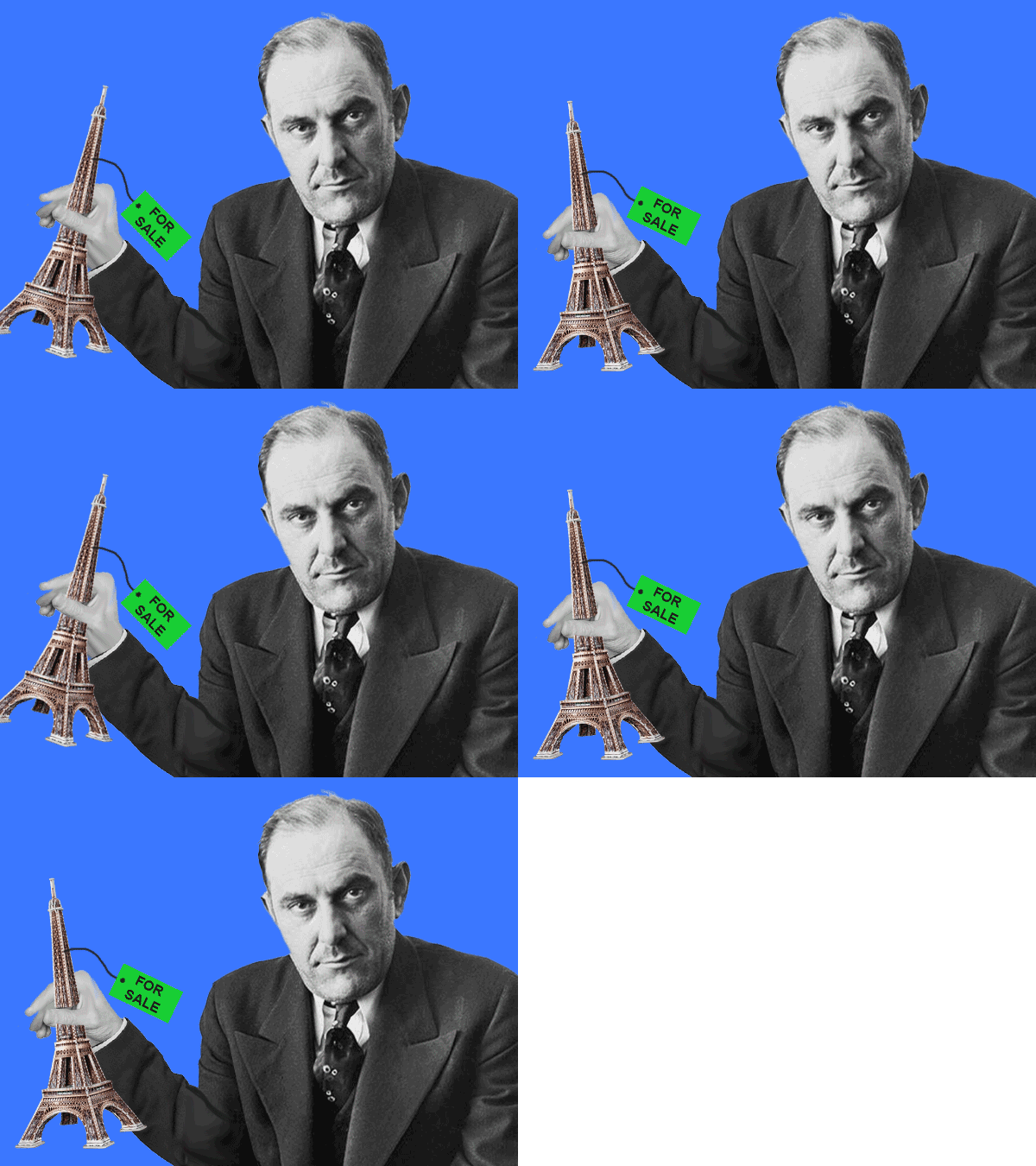
In 1925, a smooth-talking con man named Victor Lustig pulled off one of the most unbelievable scams in history: he convinced a French scrap-metal dealer that the Eiffel Tower was about to be demolished and could be purchased for scrap. Even more astonishing, historical accounts say Lustig later repeated the same scheme.
The Man Behind the Scam
Victor Lustig presented himself as a wealthy and influential European gentleman. He even used the title “Count,” although his real background was far less glamorous than the identity he created.
Lustig was known for confidence tricks, fake documents, aliases and elaborate schemes. His ability to appear respectable was one of his greatest tools.
He understood something important about deception: people were often more willing to believe someone who looked and behaved like he belonged in a powerful position.
And in Paris, he found the perfect opportunity.
Why the Eiffel Tower?
The Eiffel Tower had been constructed for the 1889 World’s Fair and was originally intended to be a temporary structure.
By the 1920s, the tower was more than three decades old. It required maintenance, and some Parisians had criticized its appearance and questioned its future.
Lustig saw an opportunity.
He reportedly read about the tower’s maintenance problems and began developing a plan to convince wealthy scrap-metal dealers that the French government had secretly decided to dismantle it.
The idea was outrageous.
But Lustig knew that the more official the story sounded, the more believable it could become.
Creating a Fake Government Operation
Lustig arranged for convincing-looking stationery and presented himself as a French government official.
He invited several prominent scrap-metal dealers to a private meeting at the luxurious Hôtel de Crillon in Paris.
There, he delivered the story.
The Eiffel Tower was supposedly going to be dismantled, and the government was allegedly looking for a contractor to purchase the enormous amount of metal.
According to historical accounts, Lustig claimed the tower contained around 7,000 tons of metal and that the right to dismantle it would go to the successful bidder.
The businessmen were interested.
After all, if the story were true, the scrap could potentially be extremely valuable.
Choosing His Target
Lustig did not simply choose the first person who showed interest.
He carefully watched the businessmen and tried to determine who would be easiest to manipulate.
His attention eventually focused on André Poisson, a relatively new figure in Paris’s scrap-metal business.
Poisson wanted to prove himself and was eager to win the deal.
Lustig used that ambition to strengthen the deception.
He reportedly suggested that his government salary was modest and hinted that a financial payment could influence the decision.
The implication was that Poisson could secure the contract by paying a bribe.
Poisson apparently believed the story.
The Deal
According to historical accounts, Poisson paid Lustig approximately $20,000 in cash, with another $50,000 supposedly connected to the successful bid.
But there was one enormous problem.
There was no government contract.
There was no secret demolition plan.
And Lustig had no authority whatsoever to sell the Eiffel Tower.
He had simply created an elaborate story, convinced a businessman to believe it and walked away with the money.
The Most Remarkable Part
Many con artists would have stopped there.
Lustig apparently didn’t.
Historical accounts say that after successfully carrying out the Eiffel Tower scam, he later attempted the same scheme again.
That is why Victor Lustig became associated with the extraordinary claim that he “sold the Eiffel Tower twice.”
The exact details of the second episode are less firmly documented than the famous 1925 scam, but the story became a defining part of Lustig’s legend.
Why Didn’t the Victim Go to Police?
This is one of the cleverest elements of the story.
After realizing he had been deceived, Poisson would have had to admit that he had paid money to influence a supposedly corrupt government official.
Reporting the scam could have been embarrassing and potentially damaging to his reputation.
Lustig understood human psychology.
His strategy wasn’t simply to make someone believe a lie.
He created a situation where admitting the truth was uncomfortable for the victim.
That gave him additional time to disappear.
The Eiffel Tower Was Never Going Anywhere
The Eiffel Tower survived.
Instead of being dismantled for scrap, it remained one of Paris’s most recognizable landmarks.
Today, millions of people visit the tower every year, making the old scam even more astonishing.
The building that Lustig supposedly “sold” is still standing almost a century later.
Lustig Had Bigger Schemes
The Eiffel Tower wasn’t the end of Lustig’s criminal career.
He was involved in numerous confidence tricks and eventually became heavily involved in counterfeiting.
One of his famous schemes involved a machine he claimed could supposedly reproduce genuine banknotes.
Victims paid large amounts of money for the device, believing they could use it to make more money.
Lustig’s ability to combine technology, psychology and theatrical presentation made his schemes particularly convincing.
The Law Eventually Caught Up With Him
Lustig’s luck did not last forever.
In 1935, U.S. Secret Service agents arrested him in connection with counterfeiting.
Authorities eventually discovered counterfeit money and other evidence connected to his criminal operations. He was later sentenced to 20 years in Alcatraz.
His career as an international con man was finally coming to an end.
The Strange Legacy of Victor Lustig
Victor Lustig remains famous because his most famous scam sounds almost too ridiculous to be true.
Selling the Eiffel Tower would seem impossible.
But Lustig understood that people don’t always make decisions based purely on facts. Confidence, appearance, authority and the promise of financial gain can sometimes be powerful enough to overcome skepticism.
His story is therefore more than an unusual crime story.
It is also a lesson in how sophisticated scams can work.
The Tower That Outlived the Con Man
Victor Lustig died in 1947, but the Eiffel Tower continued to stand above Paris.
His name eventually became attached to one of the most famous confidence tricks in history.
He didn’t actually own the Eiffel Tower.
He couldn’t legally sell it.
Yet for a brief moment, he convinced people that he could.
And that’s what made the scam so extraordinary: the Eiffel Tower was never really for sale, but Lustig managed to make someone believe that it was.

