PART 1: THE UNEXPECTED VISITOR WHO BROUGHT AN ENTIRE CLINIC TO A STANDSTILL
There are moments when an ordinary day becomes something unforgettable, when the familiar rhythm of daily life is interrupted by an event so unexpected that the people involved can scarcely believe what they are witnessing.
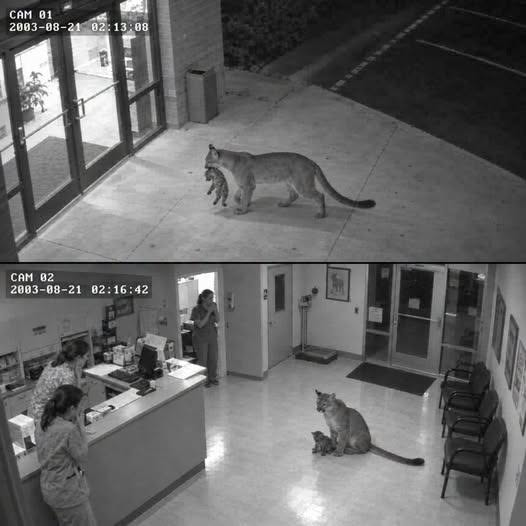
For the employees of a small veterinary clinic in Arizona, that moment began when an animal they would never have expected to see inside their building walked through the entrance carrying something precious in her mouth.
It was a mountain lion.
And she was carrying her baby.
Veterinary clinics are places where frightened animals are brought for medical attention every day.
Dogs arrive with injured paws, cats are carried inside their travel crates, and worried owners sit in waiting rooms hoping for reassuring news.
The staff are accustomed to nervous animals, unexpected emergencies, and the occasional unusual patient.
But nothing in their professional experience could have prepared them for a fully grown mountain lion entering their lobby.
The powerful wild cat moved through the doorway with the unmistakable confidence of an animal that belonged to the wilderness.
Her muscular body, long tail, and watchful eyes immediately transformed the atmosphere inside the clinic.
For a few stunned seconds, the employees could only stare.
Then instinct took over.
People stepped away from the reception desk. One employee hurried toward the treatment area, while another warned colleagues to stay back. Within moments, several staff members had taken shelter behind a closed interior door.
A mountain lion was not an animal anyone could safely approach, regardless of how calm she appeared.
Someone called 911.
Yet as the employees watched from a protected position, they noticed something that made the situation even more extraordinary.
The mountain lion was not advancing toward them.
She was not attempting to chase anyone, searching for food, or behaving as though she intended to attack.
Instead, she carefully lowered her head toward the lobby floor.
Between her jaws was a tiny mountain lion cub.
The mother gently placed the youngster on the ground and stood beside it.
The cub did not immediately scramble away or explore its surroundings. It remained almost motionless, its small body resting against the floor.
The mother lowered her nose and nudged it.
There was little response.
She tried again.
The employees, still frightened and uncertain, began to understand that something was terribly wrong.
Whatever had brought this powerful predator into a building full of humans, the cub appeared to be at the center of it.
What had first seemed like a dangerous wildlife encounter was beginning to resemble something entirely different.
A medical emergency.
And the patient was a very small mountain lion.
PART 2: A MOTHER WHO REFUSED TO LEAVE HER BABY BEHIND

From behind the treatment-room door, the veterinary employees continued observing the extraordinary scene unfolding in their lobby.
The mother mountain lion remained close to her cub.
At times, she moved a short distance away, her body tense and her attention fixed on the unfamiliar surroundings. Then she returned, lowering her head toward the little animal as though checking for signs of movement.
The cub was awake, but its behavior was concerning.
Young mountain lions are naturally curious as they grow. Although they depend heavily on their mothers for protection, healthy cubs gradually become more alert, responsive, and interested in the world around them.
This youngster showed little of that energy.
It barely moved.
Its head remained low, and it appeared too weak to respond normally to its surroundings.
The mother settled beside it, bringing her body close enough to shield the smaller animal. Whenever the cub shifted, she lowered her head, touched it gently with her nose, and kept it near her front paws.
The sight was deeply moving.
Outside the clinic, the Arizona landscape offered the mountain lion everything she normally needed: rugged terrain, secluded resting places, and the freedom to move through her natural territory.
Inside the building, however, she was surrounded by unfamiliar smells, sounds, and people.
It was not a place where a wild predator should feel comfortable.
Yet she stayed.
To the watching employees, her actions appeared to communicate something that required no words: the cub was vulnerable, and she was not willing to abandon it.
No one could know exactly what the mountain lion was thinking.
Wild animals do not understand veterinary hospitals in the same way humans do, and it would be impossible to determine whether she had intentionally sought medical assistance.
But the circumstances created an unforgettable image.
A mother had arrived with her sick baby.
And now she was standing guard.
The veterinary team faced a complicated problem.
They wanted to help the cub, but approaching an adult mountain lion without proper precautions could endanger both the employees and the animals.
A mother protecting her young can become extremely defensive if she perceives a threat.
Even a movement intended to help could trigger a dangerous reaction.
The staff knew they could not simply walk into the lobby and pick up the cub.
They needed trained wildlife professionals.
They needed a plan.
And they needed to ensure that their efforts to save the youngster did not cause its mother to panic.
As the minutes passed, the employees continued monitoring the pair while waiting for assistance.
The mother remained near the cub.
Every small movement from the youngster drew her attention.
And every passing minute made the need for professional intervention feel more urgent.
The powerful mountain lion could protect her baby from many dangers in the wilderness.
But whatever was weakening the little cub appeared to be something she could not solve through strength alone.
PART 3: WHEN FEAR TURNED INTO A DESIRE TO HELP

The arrival of wildlife responders changed the situation.
Until that point, the clinic employees had been forced to observe from a distance, concerned about the cub but understandably afraid of its mother.
Now, trained personnel could begin evaluating how to manage the encounter safely.
Handling a sick wild animal is never as simple as approaching a domestic pet.
Wildlife responders must consider the animal’s physical condition, its behavior, the surrounding environment, and the possibility that human intervention could create additional stress.
When an adult mountain lion is involved, those concerns become especially important.
The safety of everyone inside the clinic depended on careful coordination.
The mother needed to be kept from feeling trapped or threatened, while the cub needed medical attention.
After assessing the situation, the responders worked with the veterinary team to establish a controlled approach.
The priority was to keep the animals safe while allowing the medical professionals to determine what was wrong.
For the clinic employees, this was a remarkable shift in perspective.
Only a short time earlier, their greatest concern had been escaping the lobby without provoking a dangerous encounter.
Now they were focused on saving the smallest animal in the room.
The same wild cat that had frightened them was standing beside a cub that desperately needed assistance.
The employees could not forget the image of the mother touching her baby with her nose.
They had seen similar gestures countless times among domestic animals.
Mother dogs cleaning newborn puppies.
Mother cats carrying kittens to safer places.
Animals remaining close to sick or frightened offspring.
There was something familiar about the behavior, even though the animal displaying it was a predator capable of causing serious injury.
The resemblance did not make the situation safe.
But it made the emotional stakes impossible to ignore.
As the wildlife team coordinated the examination, the veterinary staff prepared to evaluate the youngster’s condition.
Every action had to be deliberate.
The goal was not to tame the mountain lion or encourage her to become comfortable around people.
It was simply to provide appropriate care to an animal in distress.
When the cub was finally examined under controlled conditions, the veterinary team began identifying the medical problems behind its unusual weakness.
The youngster was dehydrated.
It was also noticeably run-down and lacking the energy expected of an otherwise healthy cub.
Dehydration can be especially dangerous for young animals because their bodies have less ability to tolerate significant fluid loss.
An animal that becomes severely dehydrated may grow weak, lethargic, and increasingly unable to maintain normal physical function.
For a mountain lion cub still developing and depending on its mother for survival, such weakness can quickly become serious.
The veterinary team understood that the youngster needed supportive treatment.
Fluids could help address dehydration, while careful observation would allow the staff to determine whether its condition was improving.
But the situation still demanded caution.
The cub was a wild animal.
Its mother remained a powerful predator.
And even if the youngster responded to treatment, there was no guarantee that recovery would be immediate.
The employees began preparing for the next stage of the rescue.
They had moved beyond the initial shock.
Now they were watching a medical effort unfold.
And, quietly, they were beginning to hope.
PART 4: THE SMALL SIGNS OF RECOVERY THAT MEANT EVERYTHING
The first hours of treatment were filled with uncertainty.
The cub was receiving supportive care, but the veterinary staff knew that recovery could not be measured by a single examination.
They needed to see whether the youngster became more alert.
Whether its movements grew stronger.
Whether it could begin responding normally to the world around it.
For an animal that had barely been moving, even the smallest improvement mattered.
At first, there was little change.
The cub rested quietly, its body recovering from the weakness that had brought it into the clinic.
The employees continued their other duties, but their attention repeatedly returned to the unusual patient.
A veterinarian might finish examining a dog and then ask for an update.
A technician might pass the treatment area and pause briefly to see how the cub was doing.
Someone who had been frightened by the mountain lion earlier could now find themselves hoping for another sign that the youngster was recovering.
The emotional atmosphere inside the clinic had changed completely.
Fear had not disappeared.
Everyone still understood the risks involved in working around a wild predator.
But the immediate sense of danger had been replaced by a focused concern for a vulnerable young animal.
Then came a small but encouraging development.
The cub lifted its head.
It was not a dramatic movement.
There was no sudden burst of energy or miraculous transformation.
But after hours of watching an unusually weak youngster, the simple act of raising its head suggested that something might be improving.
The staff continued monitoring its condition.
Later, the cub showed greater awareness of its surroundings.
It began responding more noticeably to activity nearby.
When suitable food was offered under professional supervision, the youngster eventually showed interest and accepted a small amount.
Every positive sign was reassuring.
The little mountain lion was beginning to act more like a young animal capable of interacting with its environment.
Still, the veterinary team understood that improvement did not automatically mean the cub was ready to return to the wilderness.
A wild youngster must be strong enough to move, respond, and remain with its mother.
The ability to stand and walk was especially important.
As the hours passed, the cub gradually became more active.
It shifted its position.
It raised itself higher.
Then, after a period of rest and observation, it began making an effort to stand.
For the employees, this was one of the most memorable moments of the entire encounter.
The cub placed its paws beneath its body and pushed upward.
Its movements were cautious.
Its balance was not yet perfect.
But it was trying.
After arriving at the clinic barely able to move, the youngster was now attempting to support its own weight.
For a few seconds, it remained standing.
Then it adjusted its position.
One small movement followed another.
The employees watched the progress with quiet relief.
The frightened atmosphere that had surrounded the mountain lion’s arrival seemed almost impossible to imagine now.
Earlier, the staff had been looking for the safest place to hide.
Now they were watching a tiny predator struggle toward recovery.
They had no way of knowing what challenges the cub might face after leaving their care.
But at that moment, the signs were encouraging.
The youngster was more alert.
It was moving.
And perhaps most importantly, it was beginning to regain the strength it needed to remain beside its mother.
PART 5: THE EXTRAORDINARY BOND BETWEEN A MOUNTAIN LION MOTHER AND HER CUB
To understand why the scene inside the clinic was so powerful, it helps to understand the relationship between mountain lion mothers and their young.
Mountain lions, also known as cougars or pumas, are among North America’s most remarkable predators.
They live across a wide range of habitats, from mountainous forests to dry desert landscapes, and they are particularly well adapted to moving through rugged terrain.
Despite their size and strength, mountain lions are generally elusive animals.
They tend to avoid unnecessary encounters with humans, and many people living near mountain lion habitat will never see one in the wild.
Their secretive behavior makes close observations of family life especially uncommon.
Unlike animals that live in large social groups, adult mountain lions are generally solitary.
A major exception is the relationship between a mother and her dependent cubs.
Young mountain lions are born helpless.
They cannot immediately hunt, defend themselves effectively, or navigate the dangers of the wilderness on their own.
During their earliest weeks, they depend completely on their mother.
She provides nourishment, protection, warmth, and a safe place to rest.
As the cubs grow, she gradually introduces them to the skills they need for survival.
They learn to follow her movements.
They begin exploring their surroundings.
Over time, they develop the coordination, awareness, and hunting abilities that will eventually allow them to live independently.
But independence does not come quickly.
Mountain lion cubs may remain with their mothers for well over a year as they learn how to survive.
Throughout that period, the mother’s role is essential.
She must find enough food to support herself and her offspring while also avoiding threats that could endanger the youngsters.
If a cub becomes sick or injured, the challenge becomes even greater.
A mother can protect her offspring from many physical dangers, but she cannot necessarily reverse dehydration, treat an infection, or correct an underlying medical problem.
That is what makes the imagined clinic encounter so emotionally compelling.
The mother possessed remarkable strength.
She had the physical abilities of an accomplished wild predator.
Yet her cub’s weakness created a problem that strength alone could not solve.
The image of her remaining beside the youngster offers a familiar reminder about parental care in the animal kingdom.
Wild animals do not express affection in precisely the same ways humans do.
Their behavior is shaped by biology, experience, instinct, and environmental conditions.
Scientists must be careful not to assign human thoughts or motivations to animals without evidence.
Nevertheless, the care that many animal mothers provide to their offspring is real and essential to survival.
A mountain lion mother may move her cubs to safer locations, remain near them while they rest, and protect them when she perceives danger.
Those behaviors reflect the powerful biological investment involved in raising young.
For a species whose offspring require extensive care, that investment can mean the difference between survival and death.
Inside the fictional Arizona clinic, the mother’s repeated attention to the weak cub became the emotional center of the story.
She remained close.
She responded to its movements.
And when the youngster grew stronger, the possibility of returning together to the wilderness became increasingly real.
For the staff, the experience offered a reminder that even the most formidable predators have vulnerable moments.
The animal that had initially appeared so frightening was also a mother caring for a dependent baby.
Both realities could exist at the same time.
She was dangerous to approach.
And her cub needed help.
Recognizing both truths was what allowed the veterinary and wildlife teams to respond responsibly.
PART 6: THE MOMENT THE LITTLE CUB WAS READY TO RETURN TO ITS MOTHER
By the time the veterinary team had completed its observations, the cub’s condition had improved considerably.
The youngster that had arrived unusually quiet and weak was now displaying greater alertness.
It had begun accepting food.
Its movements were steadier.
And it was able to stand and take steps without the same obvious difficulty.
For the employees who had watched the rescue develop, these changes represented the outcome they had been hoping for.
But successful wildlife care is not simply about helping an animal survive inside a medical facility.
Whenever appropriate and feasible, the larger goal is to allow the animal to continue living naturally.
In the case of a dependent mountain lion cub, maintaining the relationship with its mother can be critically important.
A youngster that is not yet capable of hunting independently still needs the protection and experience of its parent.
Returning it safely to the mother, when possible, offers the opportunity for that natural development to continue.
The wildlife officials therefore focused on arranging a safe reunion and return to suitable habitat.
Such decisions require careful judgment.
An animal must be medically stable enough for release.
The location must be appropriate.
And the welfare of both the youngster and the adult must be considered.
For the clinic staff, the thought of the pair returning to the wilderness brought a mixture of relief and emotion.
They had become invested in the cub’s recovery.
Over the course of several hours, they had watched it change from an almost motionless youngster into a small animal capable of standing and moving again.
Now the time was approaching to let it go.
The final reunion offered the kind of image that would remain in their memories long after the clinic returned to its normal routine.
The mother was nearby.
The cub, noticeably stronger than before, began moving toward her.
Its steps were small.
It was not yet the confident predator it might someday become.
But it was moving under its own power.
The mother lowered her head toward the youngster.
The cub approached.
And the pair came together again.
There was no need for an exaggerated display.
No dramatic sound.
No grand gesture.
The significance of the moment was contained in the simple fact that the little animal could now walk toward its mother.
Hours earlier, it had barely been moving.
Now it was standing beside the animal on whom its survival depended.
The employees who had initially retreated behind a treatment-room door had witnessed a remarkable transformation.
The mountain lion had entered the clinic as an unexpected and potentially dangerous visitor.
Her cub had arrived in distress.
But through the coordinated efforts of veterinary professionals and wildlife responders, the youngster had received medical care, regained strength, and reached the point where a reunion could be arranged.
The pair’s return to the surrounding wilderness marked the end of an extraordinary encounter.
For the animals, it meant an opportunity to resume life away from buildings, roads, and human activity.
For the people inside the clinic, it meant something different.
They had witnessed the vulnerability of an animal most people associate only with strength.
They had seen how quickly fear can coexist with compassion.
And they had been reminded that helping wildlife sometimes requires both courage and restraint.
The most important act was not approaching the mother.
It was respecting the danger, allowing trained responders to manage the situation, and providing the cub with appropriate care.
That combination made the imagined rescue meaningful.
The staff did not need to become fearless.
They simply needed to respond responsibly.
And in doing so, they helped create the possibility of a very different ending.
PART 7: THE NIGHT FEAR GAVE WAY TO COMPASSION
After the mountain lions were gone, the veterinary clinic returned to the familiar sounds and routines of everyday work.
There were still animals waiting for examinations.
There were still appointments to manage, medical records to complete, and worried pet owners hoping for good news.
The ordinary responsibilities of a veterinary clinic did not disappear simply because something extraordinary had happened.
But for the employees who had witnessed the encounter, the memory would be difficult to forget.
They would remember the first moment they saw the mountain lion enter the lobby.
The shock of realizing that a powerful wild predator was standing only a short distance from the reception desk.
The urgent movement toward safety.
The closed treatment-room door.
The call for help.
And then the unexpected sight that changed everything.
A tiny cub lying quietly on the floor.
A mother standing beside it.
The repeated, gentle movements of her head as she checked on her youngster.
Those images transformed what might otherwise have been remembered only as a frightening wildlife emergency.
The employees had started the encounter concerned for their own safety.
By the time it ended, they had also become deeply concerned about the survival of the little animal.
That emotional change says something important about the relationship between humans and wildlife.
Predators often inspire conflicting reactions.
People admire their beauty, power, and independence.
At the same time, they recognize that encounters with large wild animals can be dangerous.
Both responses are reasonable.
Respecting a mountain lion does not require pretending that it is harmless.
Feeling compassion for an animal does not mean approaching it, feeding it, or attempting to make it comfortable around people.
In fact, keeping wild animals wild is often one of the most important forms of respect humans can show them.
The Arizona Game and Fish Department advises people not to approach mountain lions and to give them room to escape.
When a mountain lion appears in an unusual setting, contacting appropriate authorities is far safer than attempting a rescue without professional assistance.
That principle remains important even in a story centered on kindness.
The employees did not help the cub by ignoring the danger.
They helped by taking it seriously.
They protected themselves, contacted responders, and allowed professionals to determine how best to assist the animal.
The result was an opportunity for a sick youngster to receive care without encouraging unnecessary human contact.
The story also highlights the remarkable dedication of veterinary professionals and wildlife responders.
Their work often takes place far from public attention.
They care for animals that cannot explain what hurts.
They make decisions under pressure.
They must balance compassion with practical medical judgment.
And in wildlife situations, they have the added responsibility of protecting animals whose best future may be one in which they never depend on humans again.
Not every rescue ends happily.
Some animals are too badly injured or too sick to recover.
Others cannot safely return to their original habitats.
Young wildlife separated from their mothers may face difficult futures, even when they receive excellent medical care.
That uncertainty makes successful recoveries especially meaningful.
In this imagined encounter, the cub’s first steady steps became the symbol of everything the responders had worked to achieve.
They were small steps.
Almost ordinary, when compared with the powerful movements of a healthy adult mountain lion.
But those steps represented renewed strength.
They suggested that the youngster was becoming capable of moving through its environment again.
Most importantly, they allowed it to approach its mother.
For the people watching, that was enough.
The most memorable part of the encounter was not the appearance of a mountain lion inside a veterinary clinic.
It was not the fear, the confusion, or the emergency response.
It was the image of a vulnerable youngster recovering enough to return to the animal that had remained close to it.
The mother mountain lion would never understand the medical equipment, the decisions made by the responders, or the concern felt by the clinic employees.
She would simply return to the wilderness with her cub.
And perhaps that was the most meaningful outcome possible.
The animals did not need to become part of the human world.
They needed the opportunity to return to their own.
In the end, the story leaves us with an image that is both simple and powerful.
A mother stands waiting.
A small cub gathers its strength.
One unsteady step becomes another.
And the distance between them slowly disappears.
The people who had been afraid of the mountain lion at the beginning of the encounter are now relieved to see her youngster moving again.
The animal that first caused alarm is no longer standing in the center of a frightening emergency.
She is standing beside her baby.
And the baby is finally strong enough to follow her.
Perhaps that is why stories about animals and their young affect us so deeply.
They reveal moments of vulnerability in creatures we often imagine as invincible.
They remind us that survival depends on more than physical strength.
And they show how compassion, when combined with knowledge and appropriate caution, can create opportunities for recovery.
The wilderness is not a gentle place.
For young mountain lions, every stage of development brings challenges.
They must learn to navigate difficult terrain, recognize danger, and eventually find food on their own.
A mother can guide them through much of that journey, but she cannot protect them from every hardship.
Still, whenever a dependent cub survives illness and remains with its mother, it gains another opportunity to grow.
Another opportunity to learn.
Another chance to become the extraordinary animal it was born to be.
That is the hope at the heart of this story.
Not that a wild predator became tame.
Not that humans somehow replaced the role of its mother.
But that a vulnerable youngster received help when it needed it, recovered enough to stand, and was able to return to the wilderness where it belonged.
The clinic employees began the encounter by looking for a place to hide.
They ended it watching a little mountain lion walk toward its mother.
And although the moment itself was quiet, its meaning was enormous.
Sometimes, the smallest steps are the ones that matter most.