There are thousands of stories buried beneath the tragedy of the Titanic.
Some are stories of courage.
Some are stories of survival.
Some are stories of terrible decisions made in moments of panic.
And then there is the story of Michel Navratil.
He was not supposed to be aboard the Titanic.
His two young sons were not supposed to be aboard either.
He had taken them from their mother, traveled under a false name, and boarded the most famous ship in history without telling anyone where they were going.
By the time the Titanic struck an iceberg on April 14, 1912, Michel Navratil had transformed a family custody dispute into a desperate voyage across the Atlantic.
But in the final minutes of his life, he made one decision that would save his children.
He gave them away.
And then he stayed behind.
More than a century later, his story remains one of the most haunting chapters of the Titanic disaster.
A Father Who Refused to Let Go
Michel Navratil was born in Slovakia and later established himself in Nice, France, where he worked as a tailor.
His life was far from the glamorous world that would soon surround his name.
He married Marcelle Caretto, and together they had two sons.
Michel Jr. was born in 1908.
Edmond followed in 1910.
To the outside world, they were an ordinary young family.
But behind closed doors, the marriage was deteriorating.
Michel and Marcelle separated, and the relationship eventually ended in a legal custody dispute. Marcelle was granted custody of the boys.
For Michel, the separation was devastating.
The exact details of his thoughts during this period can never be known with certainty. What is clear is that, in the spring of 1912, he decided to take his sons and leave.
He told Marcelle that the boys would spend Easter with him.
She agreed.
She expected them to return.
They didn’t.
Michel had already made another plan.
He would take his sons across the Atlantic.
He would begin again in America.
And he would do it without telling their mother.
The Man Who Bought Titanic Tickets Under Another Name
Michel knew he could not simply board a ship under his real identity and disappear with two children.
So he borrowed the name of a friend.
On the Titanic’s passenger list, he appeared as Louis M. Hoffman, a widower traveling with his two sons.
The deception was remarkably simple.
There was no dramatic escape.
No police chase.
No desperate confrontation at a railway station.
Just a father, two small children, luggage, and three second-class tickets.
The ship was called the RMS Titanic.
At the time, she represented the height of modern engineering and luxury.
She was enormous.
She was new.
And she was widely regarded as one of the safest ships ever built.
Michel could not have known that his decision to board her would become part of one of the most famous disasters in history.
On April 10, 1912, the Titanic departed Southampton on her maiden voyage to New York.
For Michel, the voyage represented something very different from what it represented to most passengers.
It was an escape.
A new beginning.
A chance to build another life with his children.
For the two little boys, however, it was simply an adventure.
They were too young to understand that their father had taken them away from their mother.
They certainly could not understand that they were sailing toward a disaster that would change their lives forever.
Two Little Boys on the Most Famous Ship in the World
Michel Jr. was only three.
Edmond was two.
Imagine them aboard that enormous ship.
They had never seen anything like it.
The Titanic stretched farther than a city block and carried more than 2,000 people.
There were elegant dining rooms, grand staircases, cabins, promenades and endless corridors.
For a small child, the ship must have seemed almost like an entire world.
Historical accounts indicate that the boys spent time on deck and were cared for by their father.
Michel Jr. later remembered aspects of the voyage.
He remembered the sea.
He remembered the ship.
And, remarkably, he remembered very little fear during the sinking itself.
That innocence would become one of the most heartbreaking parts of the story.
Because while adults around them were beginning to understand that something terrible was happening, the two boys were simply children.
They did not know they were standing inside a catastrophe.
11:40 P.M.
On the night of April 14, 1912, the Titanic was steaming through the North Atlantic.
The sea was extraordinarily calm.
The sky was dark.
There was little wind.
At approximately 11:40 p.m., the ship struck an iceberg.
The collision was subtle.
Many passengers did not immediately understand what had happened.
But below deck, the damage was catastrophic.
Water began entering compartments that were never supposed to flood simultaneously.
The Titanic had been designed to survive certain kinds of damage.
This was beyond what its designers had anticipated.
Within a short time, the ship’s fate was sealed.
The vessel would sink.
But the passengers did not yet know that.
And Michel Navratil was about to face the most important decision of his life.
“Take My Children”
As the evacuation began, Michel dressed his boys warmly.
The Atlantic was freezing.
He knew they needed protection from the cold.
At some point during the chaos, another passenger helped Michel get the children toward the boat deck.
The evacuation was becoming increasingly desperate.
Lifeboats were being prepared.
Passengers were being separated from one another.
Women and children were given priority.
Michel understood what that meant.
He might not be allowed into the lifeboat.
His sons might.
So he carried them toward safety.
The exact wording of his final conversation with his son has been preserved through later testimony and historical accounts, although different retellings vary.
According to Michel Jr.’s later recollections, his father gave him a message for his mother.
He wanted Marcelle to know that he loved her.
He wanted his son to tell her that he had expected her to follow them to America.
And then came the moment that would define his story.
Michel handed his children to strangers.
They were placed into a lifeboat.
He watched them leave.
And he remained on the Titanic.
The Last Time a Father Saw His Sons
This is the part of the story that feels almost impossible to imagine.
Two little boys.
A freezing night.
A sinking ship.
A father standing on a deck surrounded by darkness.
He could not know whether the lifeboat would survive.
He could not know whether anyone would find them.
He could not know whether his sons would ever see their mother again.
But he put them into the boat anyway.
The lifeboat was lowered into the darkness.
Michel disappeared from their lives.
He would never see his children again.
The Titanic sank in the early hours of April 15.
More than 1,500 people died.
Among the dead was the man traveling under the name Louis Hoffman.
But his sons survived.
The “Titanic Orphans”
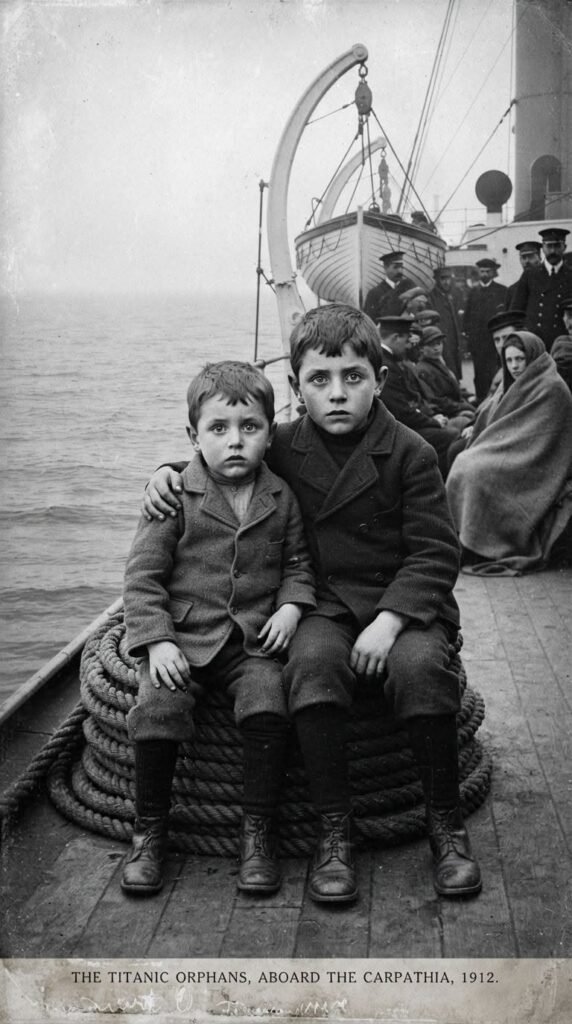
The boys were rescued aboard the RMS Carpathia.
When they arrived, however, there was a problem.
Nobody knew who they were.
They were tiny.
They spoke French.
They could not provide authorities with the information necessary to locate their mother.
And their father was dead.
Newspapers began searching for their identities.
Photographs were taken.
The image of the two little boys became one of the most recognizable photographs associated with the Titanic disaster.
They were soon described as the “Titanic Orphans.”
But they weren’t orphans.
Their mother was alive.
She simply did not know where they were.
And she had no idea whether they were alive.
A Mother Sees Her Sons in the Newspaper
Thousands of miles away in France, Marcelle Caretto was living through a nightmare.
Her husband had disappeared with their children.
She had no reliable information about where they had gone.
Then came news of the Titanic disaster.
Imagine what those days must have been like.
The ship had sunk.
Thousands were dead.
And somewhere in the wreckage of the news was the terrible possibility that her two sons had been aboard.
Then she saw the newspaper photograph.
Two little boys.
Alive.
Her children.
For weeks, Marcelle had not known whether she would ever see them again.
Now she knew.
They had survived.
The boys were eventually identified as Michel and Edmond Navratil.
The man who had taken them had not survived the disaster.
The mystery of the “Titanic Orphans” had finally been solved.
Margaret Hays and the Journey Home
While the boys waited in New York, they were cared for by Margaret Bechstein Hays, a first-class passenger who had survived the sinking.
She had helped care for the children after their rescue and became an important figure in the story of their survival.
The boys were eventually reunited with their mother in New York on May 16, 1912.
It had been more than a month since they had been taken from her.
Now, suddenly, they were together again.
Marcelle had crossed the Atlantic to retrieve her children.
The family would eventually return to France aboard the Oceanic.
For the boys, the Titanic voyage was over.
But its shadow would remain over their lives forever.
The Father Buried Under a False Name
Michel Navratil’s body was recovered from the Atlantic.
Because he had been traveling under the name Louis Hoffman, he was initially buried under that name in Halifax, Nova Scotia.
For years, the gravestone did not tell the full story.
The man beneath it had not been Louis Hoffman.
He had been Michel Navratil.
A father.
A tailor.
A husband whose marriage had collapsed.
A desperate man who took his children without permission.
And a passenger who, in the final moments, put those children into a lifeboat.
Eventually, his true identity was established and the historical record was corrected.
His grave became a physical reminder of the complicated story he left behind.
What Happened to the Two Boys?
The two boys survived.
But their lives followed very different paths.
Michel Navratil Jr. grew up in France and eventually became a respected academic.
He earned a doctorate and became a professor of philosophy.
Unlike many Titanic survivors, he was old enough to retain memories of the voyage.
He became one of the last surviving passengers with firsthand memories of the disaster.
For decades, he occasionally spoke about the Titanic and his father.
He did not remember the sinking in the same way an adult would.
His memories were fragments.
The cold.
The ship.
The lifeboat.
His father’s presence.
And the moment when he was separated from him.
Michel Navratil Jr. died in 2001 at the age of 92.
His death marked the passing of one of the final living links to the Titanic.
His younger brother Edmond followed a different path.
He became an architect and builder.
He survived another terrible chapter of European history during World War II, including imprisonment by the Nazis.
But unlike his brother, Edmond did not live to old age.
He died in 1953 at only 43.
Was Michel Navratil a Hero?
This is where the story becomes complicated.
It is tempting to call Michel Navratil a hero.
After all, he gave his children a place in a lifeboat and sacrificed his own chance at survival.
But history does not fit neatly into labels.
Michel had kidnapped his sons.
He had taken them away from their mother without her consent.
He had used a false name.
His actions before the disaster were not those of a conventional hero.
He was a desperate man.
He was a father dealing with the collapse of his marriage and his financial situation.
He made a decision that permanently changed his children’s lives.
And yet, on the Titanic, when the final choice arrived, he chose his sons.
That contradiction is precisely what makes his story so powerful.
He was not perfect.
He was not innocent.
But he loved his children.
And when faced with the ultimate sacrifice, he gave them his place in the lifeboat.
The Message That Outlived Him
Perhaps the most haunting part of Michel’s story is the message he left behind.
He knew that his sons might survive without him.
But they would eventually ask questions.
Who was their father?
Why had he taken them?
Why did he leave them?
Why wasn’t he there when they returned to France?
Michel wanted his son to tell their mother that he loved her.
Whatever had happened between the two adults, his final thoughts were connected to his family.
And the message survived because his child survived.
For more than a century, that tiny fragment of memory has kept Michel Navratil’s final moments alive.
More Than a Titanic Story
The Titanic disaster is often remembered through statistics.
More than 2,000 people aboard.
More than 1,500 deaths.
Hundreds of families destroyed.
One ship.
One iceberg.
One night.
But statistics cannot explain what the disaster actually felt like.
To understand that, you need stories.
A mother waiting in France.
Two little boys who didn’t understand why everyone was frightened.
A father standing on the deck.
A lifeboat disappearing into the darkness.
And a man who knew he would probably never see his children again.
That is what makes the Navratil story different.
The Titanic did not merely take lives.
It separated families.
It changed destinies.
It created memories that children carried for decades.
And in the case of Michel Navratil, it turned a deeply troubled family story into something the world would remember for generations.
The Final Image
Picture the final scene.
The Titanic is sinking.
The Atlantic is black and freezing.
The ship is beginning to tilt.
All around Michel are frightened passengers, shouting crew members, collapsing routines and the sound of a world coming apart.
But in his arms are two small boys.
His sons.
For all the mistakes that came before, one thing is suddenly clear.
He cannot save himself.
But perhaps he can save them.
So he gives them away.
The lifeboat descends.
The boys disappear into the night.
Michel stays behind.
Hours later, the Titanic is gone.
But his children are alive.
They will grow up.
They will have careers.
They will have families of their own.
They will remember their father.
And one of them will spend the rest of his life carrying the memory of that night.
More than a century later, we still know their names.
Michel and Edmond Navratil.
Two little boys who boarded the Titanic under a false identity.
Two children who became known around the world as the “Titanic Orphans.”
Two brothers who survived because their father made one final decision.
He gave them his place.
And then he let them go.
Perhaps that is why the story still hurts.
Because history rarely gives us people who are simply heroes or villains.
Sometimes it gives us broken people who make terrible choices — and then, in one impossible moment, make a choice that saves someone they love.
Michel Navratil’s life was complicated.
His final act was not.
When the ship was sinking, he chose his children.
And that choice survived him.