I Tried to Pull My Daughter Away From Eight Bikers at a Desert Gas Station—Then One Took Her Cookie, Turned Away, and Started Crying. That Night, I Found the Photograph That Explained What She Had Given Him
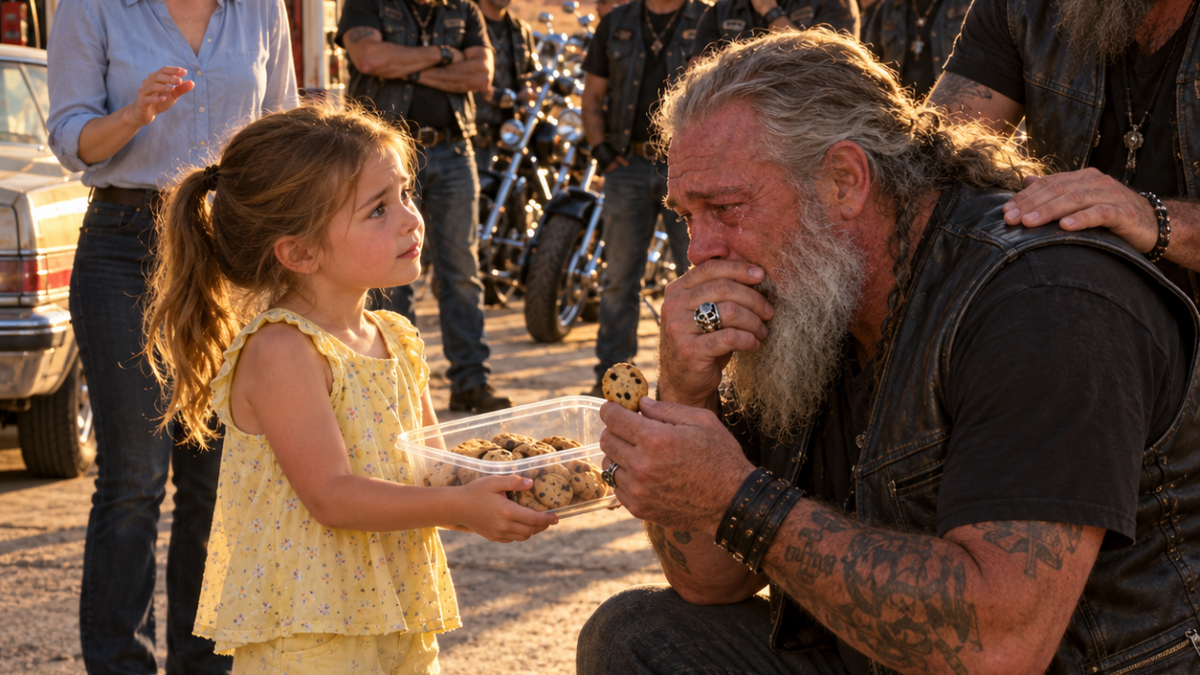
Iwas reaching for my seven-year-old daughter when the biggest biker at the gas station dropped to one knee.

She held out a plastic container.
“Would you like a cookie?”
He took one, looked at her, and suddenly couldn’t speak.
I thought I needed to protect my child from those men. Before that day ended, I would learn how badly I had misjudged them.
My name is Lauren Hayes. That summer, I was thirty-four, newly divorced, and surviving on nursing shifts that never seemed to cover everything.
My husband had left sixteen months earlier. The overdue bills stayed.
So did our daughter’s questions.
Could she still join the school art club? Would we have to move again? Why did I sometimes say I wasn’t hungry when there was only enough dinner for her?
I could handle a crowded emergency room without shaking.
Opening my banking app was another matter.
That Thursday, my daughter, Sophie, and I were driving from Albuquerque to Santa Fe for a hospital interview. A full-time position. Predictable hours. Health insurance. Enough money to stop treating every grocery purchase like a difficult decision.
Our old sedan had other plans.
The air conditioner quit before we reached the highway. The transmission hesitated on hills. By the time we pulled into a small gas station, my blouse was damp and the fuel light had been glowing for miles.
Eight motorcycles stood outside the store.
Their riders wore leather vests and heavy boots. One had a scar across his cheek. Another had tattooed arms thicker than my thighs.
They were drinking water in the shade, bothering nobody.
Still, I locked my door.
“Stay close,” I told Sophie.
She climbed out holding the cookies we had baked the night before.
“For interview luck,” she had explained while pouring far too many chocolate chips into the dough.
My mother used to bake with her. Since Mom died, Sophie had treated the old recipe card like something precious.
Inside the station, Sophie used the restroom while I prepaid twenty dollars for gas.
I checked my balance afterward.
Eleven dollars and change.
Enough for something small to eat, provided nothing else went wrong.
When we came outside, I turned toward the pump.
Sophie turned toward the motorcycles.
“Sophie.”
She kept walking.
“Sophie, come back.”
Eight heads turned.
My daughter stopped in front of the largest man, a gray-bearded rider with a faded flag tattoo on his forearm.
“Would you like a cookie? They have extra chips.”
I hurried toward her.
The man glanced at me before kneeling.
“That okay with your mom?”
I stopped beside Sophie and managed a nod.
She opened the lid.
“My grandma said you should never be stingy with chocolate.”
His smile faltered.
He took a cookie carefully, as though it might break in his enormous hand.
Then he turned his face away.
The man with the scar rested a hand on his shoulder.
For several seconds, nobody spoke.
“Did I make them wrong?” Sophie asked.
“No, sweetheart.” His voice sounded rough. “You made them just right.”
He introduced himself as Ben Walker.
The others gathered closer, each asking permission before taking one. One described his mother’s kitchen. Another insisted Sophie should open a bakery.
My daughter stood among them, delighted.
I stood beside her, embarrassed by the fear I had brought into a perfectly ordinary moment.
“We should let you get going,” I said.
Ben rose.
“She’s not bothering us.”
“Mom has an interview,” Sophie announced. “I made enough cookies to share the good luck.”
Something passed between the men.
Ben nodded slowly.
“Well, we could all use some.”
Back at the car, I pumped our twenty dollars of gas and tried to calculate how much the return trip would take.
Before I could leave, Ben approached my open window.
He stayed a few feet away.
“Would a little help with the road expenses be welcome?”
My cheeks burned.
“We’re managing.”
He nodded without arguing.
Then he offered a business card with a folded hundred-dollar bill beneath it.
“I run a repair shop outside Santa Fe. If that car keeps hesitating, call me. I know a fellow who works on cars.”
“I can’t take your money.”
“You can say no,” he said gently. “But I’d like you to have it.”
That nearly undid me.
He wasn’t demanding gratitude or making me explain my finances in front of my child.
He was simply waiting.
I accepted.
We reached the interview. A friend watched Sophie in the cafeteria while I answered questions about triage, teamwork, and handling frightened families.
For the first time in months, I could concentrate without also wondering whether we had enough gas to get home.
That night, after Sophie fell asleep, I searched the name on Ben’s card.
There were photographs of charity rides, donated toys, and free repair days for veterans.
Then I opened an older article.
Ben stood beside a woman and a little girl wearing an apron, holding a tray of cookies.
The caption said the photograph had been taken before the accident.
The man I had feared was looking at the last birthday picture of the wife and daughter he had buried.
I enlarged the photograph.
The little girl had a gap between her front teeth and a streak of flour on her cheek.
Her name was Emily.
She had been nine.
The article described the collision that took her and her mother, Rebecca, six years earlier. Ben had stayed home that afternoon to finish a customer’s motorcycle.
I put my phone down.
Then I picked it up again.
There was more.
After months when he could barely keep the shop open, his riding friends had started a fundraiser in Emily’s memory. One ride became an annual event. Eventually, they began helping families with medical expenses and repairing vehicles for people who needed transportation to work.
Near the bottom was a quote from Ben.
Emily had loved baking for other people.
Neighbors. Delivery drivers. The crossing guard outside her school.
Anyone she thought might need a better day.
I remembered his face when Sophie opened that container.
The pause.
The way his friend had touched his shoulder without asking what was wrong.
They had all understood.
I had been the only adult standing there who didn’t.
Across the hall, Sophie slept with one hand beneath her cheek. Her empty cookie container sat on the kitchen counter.
I went into her room and straightened a blanket that didn’t need straightening.
Then I sat beside her for a while.
Eight days later, the hospital offered me the job.
I cried in the grocery store parking lot, holding the phone against my ear while the hiring manager explained my start date.
Sophie cried too, although mostly because she thought crying was what we were doing.
“Happy crying?” she asked.
“The happiest.”
We bought a small carton of ice cream and ate it straight from the container.
The following morning, I called Ben’s shop.
He answered over the sound of an air compressor.
“Walker’s.”
“This is Lauren. From the gas station.”
“The interview?”
“I got it.”
His delighted laugh came through the phone before I could say anything else.
“I knew you had a good reason for those cookies.”
I asked about having the car inspected before our move. He gave me the name of the mechanic next door and offered to meet us there.
“And Ben?”
“Yeah?”
“Could we stop by your shop afterward? I’d like to thank you properly.”
There was a brief silence.
“Sure,” he said. “We’d like that.”
On Saturday, Sophie insisted on baking again.
This time, she measured the chocolate chips, considered the amount, then added another handful.
At the shop, a young mechanic held the door while I carried the container inside. Motorcycles stood on lifts. Tools hung in careful rows. A coffee machine gurgled beside a stack of mismatched mugs.
Ben came out of the office wiping his hands.
“Cookie Girl.”
Sophie grinned.
“Mom got the job.”
“So I hear.”
He congratulated me, then listened while Sophie explained her new school, our apartment search, and the possibility of getting a bedroom big enough for a desk.
He never looked toward the clock.
While the mechanic next door examined our car, Ben invited us into his office.
Photographs covered the walls.
Group rides. Hospital visits. A wedding picture.
And Emily.
Sophie noticed her immediately.
“Is that your little girl?”
Ben followed her gaze.
“Yes. That’s Emily.”
“Does she help here?”
I started to speak, but Ben shook his head gently.
“She died, honey. Her mom did too. There was an accident.”
Sophie stood still, holding the cookie container against her stomach.
“My grandma died.”
“I’m sorry.”
“I still forget sometimes. I think I should call her, and then I remember.”
Ben lowered himself into his chair.
“Yeah,” he said. “I do that too.”
Sophie looked at the photograph again.
“Mom says I can still talk about Grandma.”
“You certainly can.”
“Can I ask about Emily?”
His eyes shone.
“Please.”
“Did she like baking?”
He laughed softly and looked at me.
“She loved it.”
“What was her favorite?”
“Chocolate chip. But mostly she liked giving them away.”
Sophie considered this with complete seriousness.
Then she set the container on his desk.
“You can tell me about her while we eat these.”
Ben covered his mouth.
I turned toward the doorway, giving him a moment, but he reached for the lid.
“She used to insist the broken ones didn’t count,” he said. “You could eat as many of those as you wanted.”
Sophie nodded.
“That sounds right.”
We sat there for almost an hour.
He told us how Emily once delivered a plate of cookies to their neighbor with a note that read, You looked grumpy yesterday.
How Rebecca had laughed so hard she had to sit down.
How Emily had wanted a bakery with a drive-through window because, apparently, people should never have to park for cookies.
Sophie laughed.
So did Ben.
There were tears too, but nobody rushed to end them.
When Sophie went to wash her hands, I stayed behind.
“I owe you an apology.”
He looked up.
“At the station, I saw your friends and assumed the worst. You hadn’t done anything.”
“You were alone with your daughter.”
“I know. But I wasn’t looking at what you were doing. I’d already decided who you were.”
He rested his hands on the desk.
“Well,” he said, “you came back.”
It was such a small answer.
Somehow, it left me room to do more than feel ashamed.
I told him I had read about Emily.
He nodded.
“Some days I can talk about her. Other days I think I can, and then something catches me.”
“The cookies.”
“The cookies,” he agreed.
“I’m sorry if—”
“Don’t be.”
His voice was quiet but firm.
“Your little girl didn’t hurt me. She gave me a good memory I wasn’t expecting.”
He looked toward the sink, where Sophie was explaining something important to the young mechanic.
“For a minute, I remembered being Emily’s dad before I remembered losing her.”
I couldn’t answer.
The mechanic next door found a leak that had left our transmission fluid low. He explained the repair, gave me a written estimate, and worked out a price I could manage.
Ben helped us find an apartment lead through a friend whose sister managed a small building near the hospital.
Nobody handed us a perfect new life.
There were forms, deposits, packing boxes, and anxious nights.
But now, when I got stuck, there were people I could call.
Three weeks later, we moved.
I started work on Monday.
On Wednesday, Sophie had her first dental appointment under our new insurance.
That evening, she bit into an apple without flinching.
I stood at the sink and cried where she couldn’t see me.
A month into the job, our department discussed a community road safety event. Someone mentioned how difficult it had been to get local riders involved.
“I know someone you could ask,” I said.
Ben arrived at the planning meeting wearing a clean work shirt and carrying a notebook.
Two of his friends came too.
They listened to the emergency physicians. The physicians listened to them. By the end, we had plans for helmet fittings, first-aid demonstrations, and sessions where drivers could sit beside a motorcycle and learn how easily a rider disappeared in a blind spot.
Ben asked whether we could also collect grocery and gas cards for families traveling for treatment.
He knew exactly how quickly those expenses accumulated.
I said yes before anyone else could.
On the morning of the event, eight motorcycles rolled into the hospital parking lot.
Sophie stood beside me with two containers.
Chocolate chip and cinnamon sugar.
At first, she delivered cookies to every volunteer individually. Then Ben found her an empty table, and someone made a small sign.
She spent the afternoon solemnly explaining that donations were welcome but cookies were free.
A father with a tired toddler took one and asked for a second.
“For my wife,” he said. “She’s upstairs with our son.”
Sophie gave him four.
Near closing time, Ben stood looking at her table.
Beside the donation jar, she had placed a drawing: two little girls behind a bakery counter.
One had brown hair like Sophie.
The other had a gap between her front teeth.
Across the top, in uneven letters, Sophie had written:
Emily and Sophie’s Cookies.
“I asked Mom how to spell her name,” she explained.
Ben stared at the picture.
“If you don’t like it, I can—”
“I like it.”
He swallowed.
“I like it very much.”
That evening, we helped carry the supplies back into the hospital. The gas cards alone filled a thick envelope.
Ben tucked Sophie’s drawing carefully inside his jacket.
Before he left, I told him I wanted to repay the hundred dollars.
He looked toward the envelope in my hand.
“I think you already found somewhere for it to go.”
So I put a hundred dollars into the family assistance fund on payday.
Then I did it again when I could.
The drawing stayed in Ben’s office, framed beside Emily’s school photograph.
We visited often enough that Sophie stopped asking whether he would be there and started asking whether he had milk.
And Ben kept telling stories.
About Emily’s terrible knock-knock jokes. Rebecca singing while she cooked. The birthday cake they had dropped and served in bowls anyway.
One Saturday, I watched him and Sophie argue cheerfully over whether a cracked cookie was broken enough to be free.
For a moment, he looked toward Emily’s photograph.
Then he took another cookie.
“Definitely broken,” he said.
Sophie studied the perfectly round cookie in his hand.
“That one?”
Ben smiled.
“I’m asking for a little kindness here.”