In a new MasterClass, the Duke of Sussex opens up about carrying Princess Diana with him, his life with Meghan and their kids and the struggles he kept hidden for years
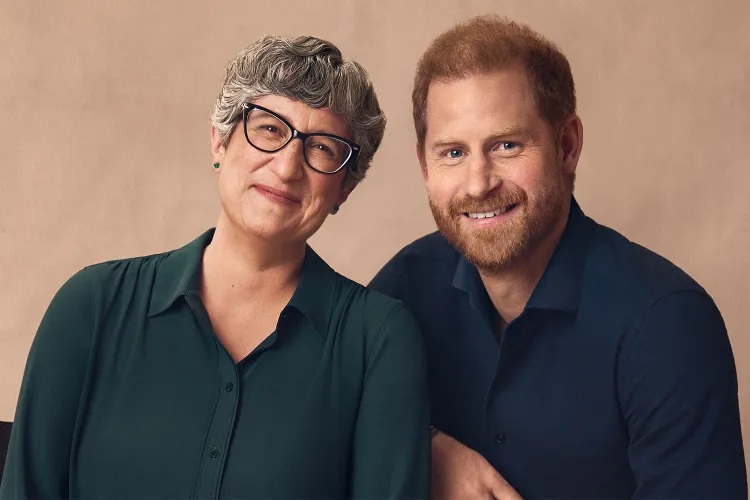
Prince Harry is opening up like never before about grief and what losing his mother, Princess Diana, at age 12 has meant for nearly every chapter of his life since.
In Redefining Grief: Building Resilience Through Loss, a new MasterClass available Oct. 8, the Duke of Sussex, 42,
sits down with neuroscientist and grief expert Dr. Mary-Frances O’Connor for an intimate
and at times deeply emotional conversation about loss, trauma and the ways grief can affect both the brain and body.
Rather than a traditional interview, the class — timed ahead of World Mental Health Day on Oct. 10 —
unfolds as a candid exchange between Harry and O’Connor,
a professor of clinical psychology and psychiatry at the University of Arizona whose research focuses on the psychological and physiological effects of bereavement.
Together, they explore the science of grief and resilience while Harry draws extensively on his own life —
from losing Diana and serving in Afghanistan to therapy, panic attacks, his marriage to Meghan Markle and life as a father.
“I didn’t cry when I was told my mom died, only at her burial, and then not again for nearly two decades,”
he says near the start of the class. “I was convinced that was strength, but it wasn’t.
It was a 12-year-old boy with no permission to fall apart and no roadmap for how to heal.”
“You would think I had the best help in the world. I’m a prince for God’s sake, but I was still grieving and didn’t have any place to put those feelings,” he continues.
MasterClass approached Harry about developing a class on grief last year, PEOPLE understands.
The class was filmed in California earlier this summer.
As part of the launch, MasterClass is supporting two organizations that help young people cope with grief: Scotty’s Little Soldiers, a U.K.
charity Harry has long championed that supports children and young people who have lost a parent who served in the British Armed Forces,
and Comfort Zone Camp, a U.S. nonprofit that provides bereavement camps for grieving children.
Both reflect a central message of the class: Finding connection with others who understand your loss can be an important part of healing.
The timing of the MasterClass arrives just weeks after Diana’s younger brother, Charles Spencer, released Swan Song: Diana,
My Sister, his own deeply personal account of his sister’s life and the tumultuous days surrounding her death.
Spencer has said that the approaching 30th anniversary of Diana’s death was part of what prompted him to finally put his memories down on paper.
That milestone is now less than a year away. Diana died on Aug. 31, 1997,
at age 36, and PEOPLE understands that Harry has been exploring a number of ways to honor his mother and her legacy ahead of the 30th anniversary in 2027.
A documentary about Diana is among the possibilities that have been discussed, although no project has been finalized or confirmed.
Harry uses the MasterClass to look not only at what he lost, but at how the loss continued to shape him long after Diana died.
In his conversation with O’Connor, he speaks about forgetting the sound of his mother’s voice, using her perfume to unlock memories,
suffering an emotional crash after moving to Canada with Meghan and Prince Archie, and the “absolute panic” he once experienced during public engagements.
He also opens up about where he is today — including the photograph of Diana he keeps close,
his 10-day rule for time away from Meghan and their children and why he believes psychedelic-assisted therapy is moving into the mainstream.
Here are 11 of Prince Harry’s most revealing moments from Redefining Grief: Building Resilience Through Loss.
He felt guilty about being happy without Princess Diana
For years after Diana’s death, Harry says happiness itself could feel like a betrayal of his mother.
He describes worrying that healing from his grief might somehow weaken his connection to her.
“I’d spent so long emotionally numb, to a large extent, because I felt disloyal and guilty for the possibility of being happy and joyful without her,” Harry says.
“I felt like I had to be sad and I had to be emotionally numb in order to prove to her that I missed her.”
Eventually, he says, his perspective changed dramatically.
“But the reality is, what I discovered was actually she just wanted me to be happy,” Harry says.
“And that was a huge mental shift for me. It freed me, and it gave me a whole different outlook on life.”
He forgot what his mother’s voice and laugh sounded like
Harry says that after Diana died, shutting down his painful memories had an unintended consequence: He lost access to happy ones too.
“The defense mechanism for the mind and the body was shut down the emotions and shut down the memories,” he says. “Not just the bad memories, the good memories as well. I forgot what my mom sounded like. I forgot her laugh. I couldn’t really visualize what she looked like without looking at a photograph of her.”
Earlier in the class, Harry says he did not cry when he learned Diana had died and only broke down at her burial — after which he didn’t cry over her death again for nearly two decades.
“It took me a long time to find my path to resilience. I didn’t cry when I was told my mom died, only at her burial,
and then not again for nearly two decades,” he says. “
I was convinced that was strength, but it wasn’t.
I was a 12-year-old boy with no permission to fall apart and no roadmap for how to heal.”
Princess Diana’s perfume helped unlock his memories
Years later, Harry says a therapist suggested he seek out his mother’s perfume as a way of accessing memories that had become difficult to reach.
“And it was like being transported to another time,” Harry says. “And it unlocked everything that had been locked previously.”
He describes the experience as breaking through an emotional wall he had built after Diana’s death.
“But spraying my mother’s scent was almost like knocking certain bricks through so that I could see through and certain memories and experiences could start seeping through.”
He “slipped into depression” after leaving the U.K.
Harry also recalls what happened after he, Meghan and then-baby Archie moved to Canada in late 2019 amid the couple’s decision to step back from royal life.
Harry says that after leaving, he experienced an “adrenaline crash” within days.
“We moved to Canada to get some space away from everything, just to be able to think,” he says.
“Being in Canada, away from the stressful environment where presumably my body was just pumped full of adrenaline,
within two or three days, I experienced this adrenaline crash — something that I’d never experienced before.”
“It was as if I needed stress in order to get the adrenaline to make my brain function because I became useless around the house,” he says.
“I actually slipped into depression for about two weeks and I felt like I couldn’t function without adrenaline.”
The experience came after years in which Harry says adrenaline had helped propel him through his life — including his military service.
Royal engagements once caused him “absolute panic”
Harry gives a particularly vivid description of the anxiety he once experienced carrying out public duties.
“There was a time where public engagements just created absolute panic right from beginning to end,” he says.
“The panic was having to put my suit, jacket, and tie on and suddenly feel suffocated. The panic was going from A to B, getting out of the car in front of all the cameras and the clicks.”
“I started to realize that I had become seriously depleted when just putting a simple dress shirt on — the tightening of the collar —
literally felt like I was suffocating, and I would be experiencing panic attacks just in the car on the way to work,” he says.
“And that’s when I realized, okay, there’s something bigger, there’s something else that you need to look into here.”
Harry says another layer of anxiety came from entering a room without knowing what people would say to him, but one fear stood out.
“The biggest anxiety that was created for me was the fear of sweating,” he says.
“It was the fear of people seeing me looking disheveled and me not being able to explain to them in one short sentence what’s actually going on. I would feel like I’ve just been in a boxing match.”
He adds that public appearances can still provoke a physical reaction.
“There are some public engagements that still involve adrenaline,” he says with a laugh. “I’m not gonna lie there.”
He has a 10-day rule for time away from Meghan and their kids
Today, Harry says the happiness he finds in his family helps him balance the demands of his work.
“The biggest factor for me is the energy and the joy and happiness that I get being with my family,
especially our kids, and the joy and happiness I get by being on the ground for my work,” he says.
And he has a specific rule for maintaining that balance.
“And the key to finding the joy and happiness balance is no more than 10 days away from my wife and kids,” Harry says.
“This is balancing my work and the purpose behind that as well as being a dad and a husband and the sort of multi-identity elements coming together.”
He says he feels “so much of my mother within me”
Nearly three decades after Diana’s death, Harry says his mother remains a presence in both his personal life and the work he chooses to pursue.
“Everything I do, everything I put my energy towards, I hope that my mother will be proud about it,” he says.
“Trying to continue and protect her legacy, what I didn’t realize was the work that I ended up choosing or the work that I ended up getting drawn in and attracted to was so similar to the, to the work that she was doing as well.”
Harry says grief has left him with a sense of “carrying” Diana throughout his life.
“There is an element of me carrying my mother in me that ultimately energizes me for the work that I do,” he says.
“I felt for many years now, um, especially in the last six, so much of my mother within me.”
He also describes moments when he believes he feels Diana’s presence.
“A lot has happened in my life in the last six years, and she has turned up at moments where it makes complete sense that she turned up in those moments,” Harry says.
“But I know that if I work harder, that I can be connected to her more often than these sort of fleeting moments.”
Of those experiences, he says, “There is no version of where this is anything else but you.
I feel it as, as an energy. And also it’s visual. It’s a sign. And it’s very much connected to her.”
And when times are difficult, Harry says he still turns to his mother for guidance: “Hi, I need some help here. Guide, guide me in the right way.”
He wonders what Diana thinks of his life when he looks at her photograph
Harry says his relationship with his mother’s memory today is strikingly different from when he was a child.
He recalls that even though he had photographs of Diana in his bedroom at school,
he “distinctly remember[s] not thinking about my mother because thinking about something that sad… was never gonna bring her back.”
Now, when asked how often he thinks of Diana, Harry says, “Pretty much every night and then most mornings.”
He also keeps a particular photograph of his mother close.
“I can actually get eye contact from her and there’s a cheekiness in her smile,” Harry says as he shows O’Connor the framed photo, taken by photographer Patrick Demarchelier at Diana’s Kensington Palace apartment in late 1995 for a Harper’s Bazaar cover shoot.
“The eyes — I just feel very connected to her,” he continues. “
And I do, I find myself looking at her and wondering what is she thinking about what I am doing right now.”
Harry says he sometimes finds himself “looking to see if the facial expression changes, but it never does.”
He says psychedelic-assisted therapy is becoming “mainstream”
Harry, who has previously spoken about his own experiences with psychedelics in his best-selling memoir, Spare, also addresses the growing research into psychedelic-assisted therapy, particularly for veterans.
“Having witnessed how psychedelics are helping veterans and others who are suffering,
it really excites me to see support for this research getting more traction across party lines here in the U.S.,” he says.
Harry says he sees particular potential in combining traditional therapy with what he calls “modern day medicines.”
“But to combine conventional therapy with modern day medicines breaks down those walls and those barriers to be able to open yourself up and go deeper than you would ever dare to go,” he says.
“Psychedelic assisted therapy is no longer a fringe idea or thought. It’s really becoming, I think, mainstream.”
He says the military became the “perfect distraction” from his grief
Harry also connects the adrenaline he experienced for years after Diana’s death to his decision to join the military at age 20.
“And for 15, 20 years, when I was being asked, ‘Are you okay?’ My response was, ‘I’m fine.’ It was numbness, emotional shutdown,”
he says. “And without knowing it, adrenaline was pushing me, was driving me.
It was the driving force of what took me to joining the military at the age of 20. It was the perfect distraction.”
When Harry returned from his second tour of Afghanistan in 2013, he says the absence of a mission left him confronting emotions he had suppressed for years.
Although Harry says he gave others the impression that he was “absolutely fine,” privately, he began pulling away.
“I withdrew from a lot of my friends from socialization. I would be much more comfortable sitting at home watching Friends,” he says.
He also began searching for help. “Unfortunately, it was a number of general practitioners, GPs who weren’t equipped to be able to help me,” Harry says. “It was a case of some advice or take this pill.
And I was so against taking a pill. I was taking the advice, but it wasn’t making any difference. So I kept looking for something that would work for me.”
Harry later says that when everything caught up with him, “what was very interesting was my post-traumatic stress was not tied to Afghanistan.” Instead, he says,
“The things that I saw, the things I experienced appeared to be a trigger for other traumas that had stored themselves within me.”
Therapy finally gave him “permission to grieve”
Harry says therapy ultimately helped him confront emotions he had spent much of his life suppressing.
“One of the greatest things that I got from therapy was permission to grieve,” he says.
“Sitting in a room with a complete stranger and having the ability, the confidence and the trust to be able to open myself up.”
The effect, he says, was immediate and profound.
“I learned more about myself in two or three sessions than I had done in 20 years,” Harry says.
“First of all, she helped me accept and acknowledge that I was grieving and that it was okay to grieve and that what happened to me was really quite hard.”
Harry says being able to name and acknowledge what he had experienced allowed him to begin “the process of recovery and healing.”

