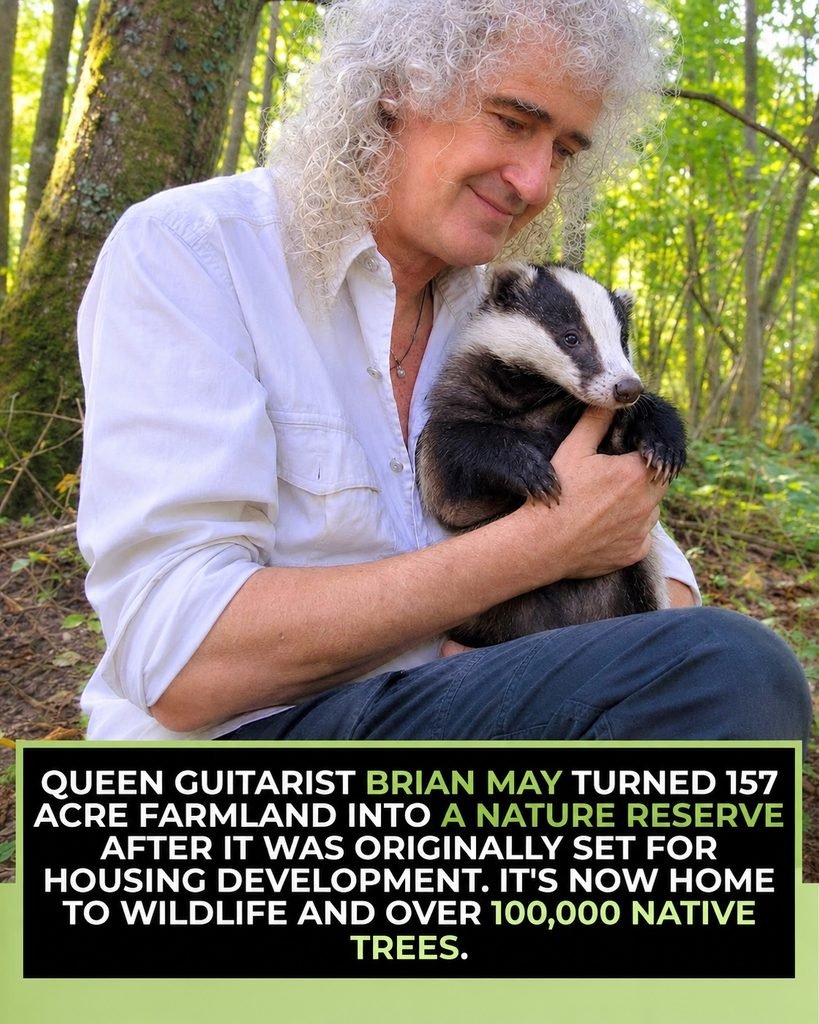
When people think of Brian May, they usually remember the legendary guitar riffs, unforgettable songs and worldwide success of Queen. But away from the stage, the rock star has been working on something very different — creating a better future for wildlife.
Instead of allowing 157 acres of former farmland in Dorset, England, to remain agricultural land or face development, May helped give it a new purpose. His vision was to transform the land into a thriving woodland where native trees, plants and animals could flourish.
Today, the project, known as May’s Wood, stands as a remarkable example of how one person’s commitment to nature can help transform an entire landscape.
From Farmland to a Woodland Sanctuary
The story began in 2013, when Brian May launched a project to create a new native woodland near the village of Bere Regis in Dorset. Working through his wildlife charity, the Save Me Trust, he wanted to turn the former agricultural land into a safe haven for nature.
The plan was ambitious: more than 100,000 native trees and shrubs would be planted across the 157-acre site.
May also wanted the woodland to connect existing natural habitats, giving wildlife more opportunities to move around the countryside. Rather than creating a space filled only with trees, the project included wildflower areas and open spaces to support different species.
The first tree was planted during a community event in September 2013, with local residents and children joining the effort. What began as a conservation vision gradually became a project that the whole community could take pride in.
More Than 100,000 Trees and Shrubs
More than a decade later, the results have been remarkable. According to the Save Me Trust, around 101,000 trees and shrubs have been established across the woodland.
But the real achievement is not simply the number of trees.
As the young woodland developed, wildflowers began appearing, while insects, butterflies, bees, birds and small mammals found new places to feed, shelter and thrive. Areas that had once been used for growing crops were gradually becoming a much richer natural environment.
The woodland demonstrates how restoring land can benefit far more than the trees themselves. A healthy habitat provides food, shelter and space for wildlife, helping different species live alongside one another.
A Special Place for British Wildlife
Brian May has long been associated with animal welfare and wildlife conservation. His work through the Save Me Trust reflects his concern for animals and the natural environments they depend on.
Badgers have also been an important part of his wildlife campaigning, particularly through his opposition to badger culling. His woodland project represents another way of supporting British wildlife: protecting and restoring the habitats animals need.
For animals living in the countryside, places with trees, plants and natural cover can make a real difference. May’s Wood was created with that bigger picture in mind — giving nature room to recover and flourish.
Brian May’s Legacy Beyond Music
Brian May has already secured his place in music history as the guitarist behind some of Queen’s most celebrated songs. Yet May’s Wood represents a different kind of achievement.
The trees planted through the project will continue to grow, and the woodland will keep developing long after the first planting day. Future generations may walk beneath trees that were once tiny saplings planted as part of one man’s conservation dream.
It is a reminder that success does not always have to be measured in awards, records or money. Sometimes, it can be measured in the wildlife that returns, the trees that grow and the natural spaces preserved for the future.
Brian May may be famous for making music that has brought joy to millions, but through May’s Wood, he is helping create something that nature — and generations to come — can enjoy for years.
And perhaps that is one of the most meaningful legacies a rock star could leave behind.