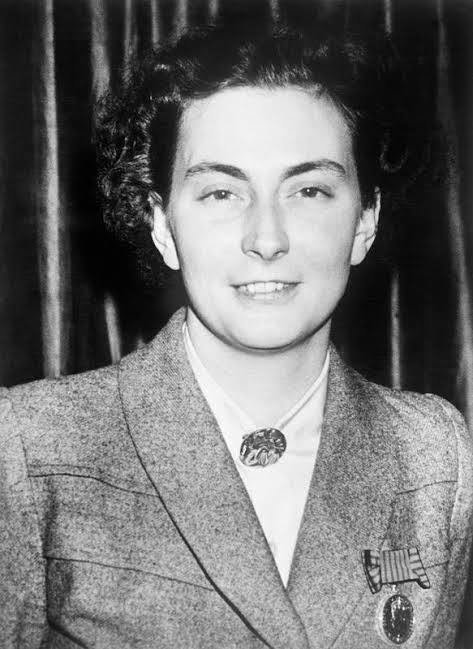
and Left Fame BehindBILBAO, SPAIN — In the freezing dark of a 1941 winter night, a twenty-four-year-old woman knocked on the door of the British consulate in Bilbao, Spain.
Standing beside her were a Belgian soldier and a Scottish pilot whom she had just guided on foot across the treacherous Pyrenees mountains.Calling herself Andrée de Jongh, she calmly explained that she had built an underground escape line stretching all the way from German-occupied Belgium.
She told officials she could keep rescuing stranded men—but needed funding to keep the operation alive.At first, no one believed her. The British consulate cabled London, and the response came back cold and dismissive.
Officials suspected a trap set by the German secret police, convinced it was impossible for a young woman of her age to pull off such a daring operation.
Denied money and support, Andrée didn’t argue or quit. Instead, she turned around and hiked right back over the harsh mountains into occupied territory to keep her word.Inspired by a Childhood HeroineRaised in
Brussels as the daughter of a schoolteacher, Andrée had been shaped early on by the story of Edith Cavell, a British nurse executed during World War I for helping Allied soldiers escape. That story never left her.When German forces marched into Brussels in May 1940, Andrée was working as a commercial artist.
She refused to stand by passively. She began by volunteering to help wounded soldiers, setting up safe houses, and moving men between hidden locations. Soon, she realized hiding them wasn’t enough—stranded troops and shot-down airmen needed a way out of occupied Europe to fight again.
Building the Comet LineAndrée designed a grueling, thousand-mile escape route running from Brussels through Paris, down to southern France, and over the steep Pyrenees into neutral Spain. She named it the Comet Line.
Every step carried mortal risk:Checkpoints were everywhere, cities were filled with informants, and turning in an Allied soldier came with a hefty financial reward.A single mistake meant death, yet Andrée rallied ordinary people—farmers hiding men in barns, priests offering sanctuary, and families sharing scarce rations and beds.
She personally forged identity papers, memorized train timetables, and studied enemy patrol patterns.Once refugees reached southern France, Andrée personally led them through the hardest stretch of all. Crossing the Pyrenees meant two full nights of exhausting hiking over steep trails—snow-covered in winter, slick with mud and rain in spring—alongside terrified, exhausted, and often injured men.”Keep moving,” she would tell them in a quiet, firm voice. “Do not stop.
“She made that punishing trek thirty-three times.Captured, Underestimated, and LiberatedEventually, London recognized the truth and gave her the code name “Dedee,” backing a network that saved 118 Allied airmen through her direct efforts.
Still, the Gestapo was closing in.In January 1943, at age twenty-six, Andrée was captured at a remote farmhouse in the French Basque country. During weeks of brutal interrogation, she looked her captors in the eye and said, “I am the one who organized everything.
I did it alone to protect the others.”The Gestapo refused to believe a young woman was the mastermind behind one of Europe’s most effective escape lines. Underestimating her, they didn’t execute her immediately—sending her instead to the Ravensbrück concentration camp, and later to Mauthausen. She endured more than two years of camp horrors until American forces liberated her in 1945.
Thirty Years of Quiet Service After the WarBy war’s end, Andrée was twenty-eight. Belgium, the United Kingdom, and the United States awarded her medals and military honors, which she accepted politely before stepping away from the spotlight.
She trained as a nurse and spent the next thirty years working in remote leper colonies across Africa—including the Congo, Ethiopia, and Senegal—caring for forgotten communities without seeking fame or applause. Asked later why she chose such a demanding life after surviving the war, her answer was simple