n January 27, 1945, soldiers of the Soviet Army’s 322nd Rifle Division approached a place that had become a symbol of one of the darkest chapters in human history.
They were advancing through Poland as Nazi Germany was collapsing.
They expected to encounter another abandoned military site.
Instead, they found something that would forever change the way the world understood the Holocaust.
They found Auschwitz.
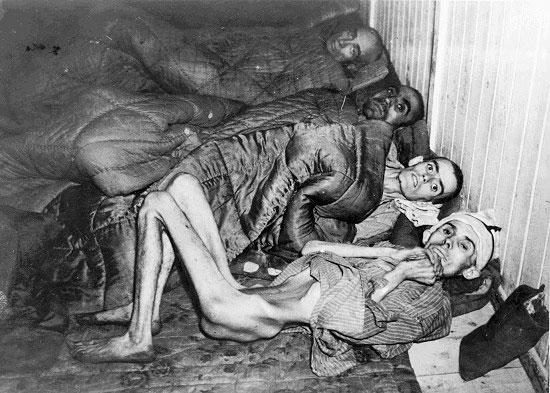
Behind the gates of the camp were thousands of prisoners who had survived years of starvation, forced labor, fear, and unimaginable suffering.
The soldiers who entered that day were prepared for battle.
They were not prepared for what waited inside.
Auschwitz was not just a prison.
It was the largest Nazi concentration and extermination camp complex.
For years, it had been a place where millions of people were imprisoned and where mass murder was carried out as part of Nazi Germany’s systematic persecution of Jews and other targeted groups.
By the time Soviet troops arrived, the Nazis had already attempted to hide evidence of their crimes.
As Soviet forces approached, Nazi authorities had evacuated many prisoners in what became known as death marches.
Thousands were forced to leave the camp under brutal conditions.
Those who remained were often too sick or weak to move.
When the gates finally opened, approximately 7,000 prisoners were still alive inside Auschwitz.
But liberation did not immediately mean recovery.
For the survivors, freedom came with another battle.
The soldiers found people whose bodies had been weakened by years of starvation and abuse.
Many were suffering from severe malnutrition.
Many were ill.
Many had lost the strength even to stand.
The first priority was simple:
Keep them alive.

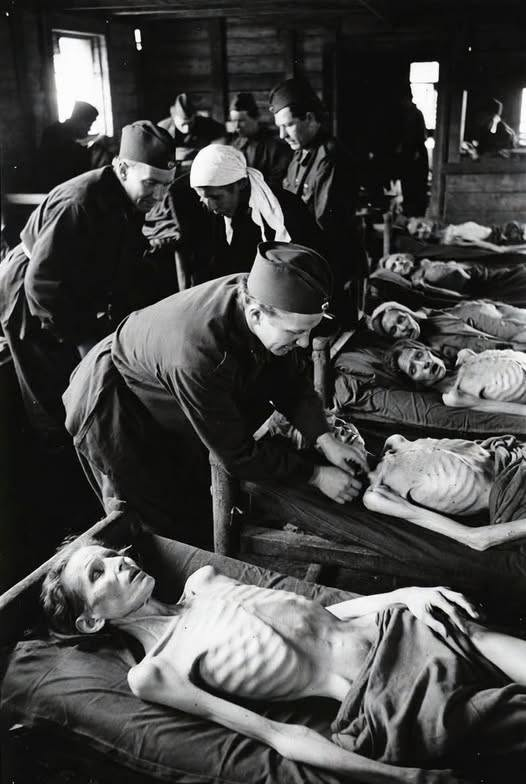
Medical units immediately began organizing emergency care.
The wooden barracks that had once been places of suffering became temporary hospitals.
Doctors and nurses worked under extremely difficult conditions.
They treated prisoners suffering from diseases including typhus and dysentery.
They cared for people whose bodies had been pushed to the edge of survival.
They faced a challenge unlike any ordinary medical emergency.
Many survivors were so severely malnourished that even feeding them required careful planning.
After months or years of starvation, suddenly giving a weakened body too much food could be dangerous.
Doctors had to provide nutrition slowly and carefully, allowing survivors’ bodies to begin recovering.
The process was not quick.
Freedom had arrived.
But healing would take time.
For the survivors, the first days after liberation were filled with complicated emotions.
There was relief.
The guards were gone.
The gates were open.
The constant fear had ended.
But there was also grief.
Many survivors did not know what had happened to their families.
They did not know who was still alive.
They carried memories of people who had disappeared.
Liberation meant survival.
But it also meant facing the painful reality of everything they had lost.
The medical teams continued working to save as many lives as possible.
Thousands of survivors received treatment.
Approximately 4,500 were cared for and gradually evacuated from the camp as their condition improved.
Each person carried a story.
Each survivor represented a life that Nazi Germany had attempted to erase.
The world would soon begin learning about those stories.
Among those who documented the aftermath were Soviet cameramen who filmed the conditions inside Auschwitz shortly after liberation.
Their footage captured the reality of what had been discovered.
The images showed survivors inside the camp.
They showed the abandoned barracks.
They showed evidence of the Nazi system of persecution and murder.
The footage became some of the earliest visual documentation of Auschwitz after liberation.
Later, it was presented during the Nuremberg Trials, where Nazi leaders were held accountable for war crimes and crimes against humanity.
The images served as evidence.
They showed the world that the stories of survivors were not exaggerations.
They showed the reality behind the crimes committed during the Holocaust.
But perhaps the most important part of Auschwitz’s liberation was not only what was discovered.
It was who was found.
The survivors.
People who had endured what seemed impossible.
Children who had lost their childhoods.
Parents who had lost their families.
Individuals who had been reduced to numbers but still carried their identities, memories, and hopes.
The world often remembers liberation as a moment when suffering ends.
But for many Auschwitz survivors, January 27, 1945 was only the beginning of another difficult journey.
Their bodies needed healing.
Their minds needed time.
Their lives had to be rebuilt from almost nothing.
Sadly, not everyone who survived the camp lived long enough to experience a full recovery.
Some prisoners died in the weeks after liberation because their bodies had suffered too much damage.
They had survived the camp, but their health had already been permanently affected.
This painful reality is one of the tragic truths of liberation.
Freedom did not erase the consequences of years of suffering.
The soldiers who entered Auschwitz brought an end to one chapter of horror.
But they also witnessed the enormous human cost left behind.
Today, January 27 is recognized internationally as International Holocaust Remembrance Day.
The date was chosen because it marks the liberation of Auschwitz.
It is a day to remember the victims.
It is a day to honor the survivors.
And it is a day to reflect on the dangers of hatred, discrimination, and the destruction of human dignity.
The story of Auschwitz is not only about the crimes committed there.
It is also about the people who survived.
It is about the medical workers who fought to save lives after liberation.
It is about the soldiers who opened the gates.
It is about the survivors who found the strength to continue living.
When the Soviet troops entered Auschwitz in January 1945, they found a place that represented humanity’s darkest possibilities.
But they also found something else.
They found people who had endured unimaginable suffering and were still alive.
Still breathing.
Still hoping.

The liberation of Auschwitz was not the end of the survivors’ struggles.
But it was the moment when the world finally began to see the truth.
The gates opened.
The silence was broken.
And the stories of those who survived could finally be heard.