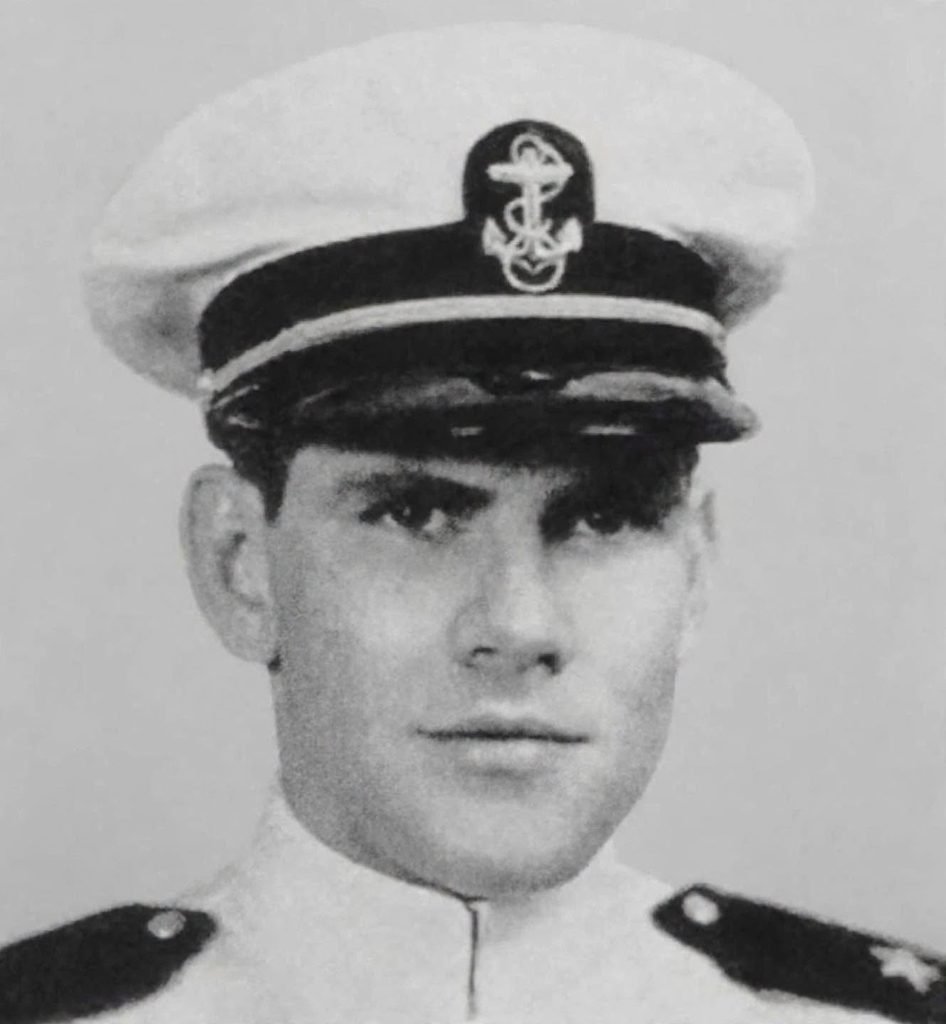
War is filled with stories of unimaginable sacrifice, but some tragedies are so heartbreaking that they deserve to be remembered for generations.
The story of Lieutenant William Francis Goodwin Jr. is one of them.
He was just 24 years old, a young American Navy pilot with a promising future, a loving wife, and a family he hoped to return to after the war.
But on November 24, 1944, his life came to a brutal end in the Pacific during World War II.
What makes his story even more heartbreaking is that his wife was expecting their first child — a baby boy who would be born five months after his father’s death.
A Young Man Who Dreamed of Serving His Country
William Francis Goodwin Jr. was born on March 11, 1920, in Plymouth, Massachusetts, to William and Katherine Goodwin.
Like many young Americans of his generation, he eventually chose a life of military service.
He enlisted in the United States Navy and pursued his dream of becoming a pilot.
In 1943, he graduated from flight school at Naval Air Station Pensacola, Florida.
He was assigned to fly PBY Catalina aircraft, which played an important role in reconnaissance, patrol, and military operations across the Pacific.
For William, it was an opportunity to serve his country while building a future for himself.
A Marriage and a Future That Would Never Come
In 1944, William married Valerie Ena Storey, a woman from Melbourne, Australia.
Their marriage represented the beginning of a new chapter filled with hopes and dreams.
But the war was far from over.
William continued his dangerous military assignments in the Pacific, while Valerie hoped that one day her husband would return home safely.
Neither could have imagined how tragically their lives would change.
The Night His Aircraft Never Returned
During a night mission near the Celebes Islands, off present-day Indonesia, William and his crew were flying their PBY Catalina when their aircraft was shot down during an operation against Japanese shipping routes.
The surviving crew members were eventually captured and handed over to the Japanese Navy by local people friendly with Japanese forces.
Instead of returning home as prisoners of war, William and his fellow airmen faced a horrific fate.
Their capture would become the beginning of one of the darkest chapters in this young pilot’s life.
November 24, 1944 — A Horrific War Crime
On November 24, 1944, William Goodwin Jr. and his crew were taken to an open pit.
According to the account, they were blindfolded, their arms tied at their sides, and forced to kneel.
Then, their Japanese captors beheaded them.
William was only 24 years old.
He would never see his wife again, never hold his newborn son, and never return to the home he had left behind.
It was a devastating loss for a family that had been waiting for him to come home.
His Son Was Born Without Ever Meeting His Father
Five months after William’s death, his son was born.
The baby was named William, carrying forward the name of a father he would never have the chance to know personally.
His widow, Valerie, eventually emigrated to the United States with their son.
They settled in America and reconnected with William’s grandparents in Plymouth, Massachusetts.
Although Valerie later remarried and built another chapter of her life in California, the memory of her first husband remained part of their family history.
She passed away on January 15, 2002, at the age of 75.
Justice After the War
After World War II ended, investigators recovered the remains of the executed American airmen.
William Goodwin Jr. was eventually laid to rest at the National Memorial Cemetery of the Pacific in Hawaii, in Section F, Site 586.
He also has a memorial marker at Saint Joseph’s Cemetery in Plymouth, Massachusetts.
The individuals responsible for the executions faced postwar legal proceedings.
According to the account, Ensign Sazae Chiuma was sentenced to ten years in prison in 1948 but served only three years.
The admiral who ordered the executions received a death sentence.
These proceedings became part of the painful history of wartime atrocities in the Pacific.
A Son Determined to Remember His Father
Perhaps one of the most meaningful parts of William’s story is that his family did not allow his memory to disappear.
Michael Goodwin eventually wrote a book about his father’s execution titled Shobun: A Forgotten War Crime in the Pacific.
The book helped preserve a story that might otherwise have remained buried in the pages of history.
It was not simply about a military tragedy. It was about a young husband, an unborn child, a grieving widow, and a family forced to live with a loss that could never be repaired.
A Life Cut Short, But Never Forgotten
William Goodwin Jr. left behind far more than a military record.
He left behind a wife who had been waiting for him, a son who would grow up without knowing his father’s embrace, and a family that carried his memory across generations.
He was only 24 years old when his life ended.
Today, his resting place and the book written about his death serve as reminders of the human cost of war.
He never got to meet his son. His son never got to hear his voice. But decades later, his story still speaks for him.
Some heroes never get the chance to return home, but their sacrifice deserves to be remembered forever.