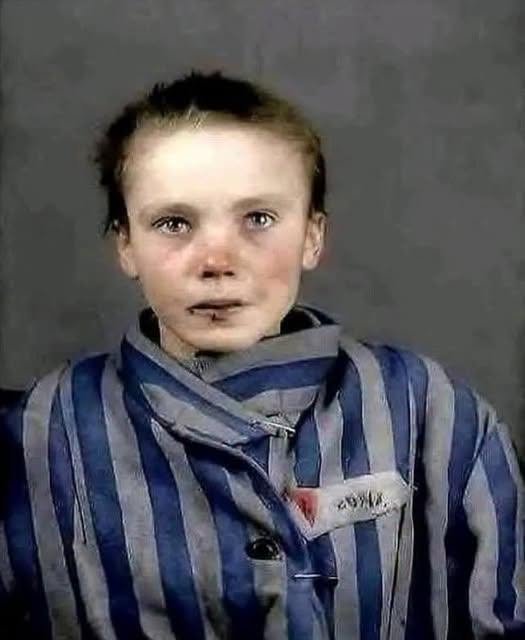
Some photographs capture a moment in history. Others preserve the face of someone the world must never forget.
The photograph of Czesława Kwoka is one of those images.
A young girl wearing a striped concentration camp uniform, with frightened eyes and a visible injury on her lip, she became one of the most heartbreaking faces associated with the horrors of Auschwitz.
She was only 14 years old when her life was brutally taken away.
Behind that photograph was a child who had lost her mother, been separated from everything familiar, and found herself trapped in one of the darkest places in human history.
Her name was Czesława Kwoka.
Who Was Czesława Kwoka?
Czesława Kwoka was a young Polish Catholic girl born on August 15, 1928.
She lived with her mother, Katarzyna Kwoka, before the Second World War changed their lives forever.
Like countless other Polish families, they became victims of the Nazi occupation.
In December 1942, Czesława and her mother were deported to Auschwitz-Birkenau, the notorious Nazi concentration and extermination camp.
Czesława was just 14 years old.
She had been taken away from her home, her childhood, and the life she should have been allowed to enjoy.
The Photograph That Preserved Her Final Days
At Auschwitz, prisoners were photographed as part of the camp’s identification procedures.
One of the photographers responsible for documenting prisoners was Wilhelm Brasse, a Polish prisoner who was forced to work in the camp’s photography unit.
He photographed Czesława in January 1943.
In the photograph, she wears a striped camp uniform and looks directly toward the camera.
Her expression is difficult to forget.
She appears frightened and vulnerable, with a visible injury around her lip.
According to Brasse’s later testimony, a female guard had struck her shortly before the photograph was taken because the young girl did not understand the German instructions.
She did not speak the language and was already suffering from the trauma of losing her mother.
Brasse later recalled how deeply the incident affected him.
He could not change what was happening around him, but he managed to preserve an image that would eventually become part of the historical record.
She Had Already Lost Her Mother
One of the most heartbreaking details of Czesława’s story is what happened to her mother.
Katarzyna Kwoka died in Auschwitz on February 18, 1943.
Her daughter was left alone in the concentration camp, separated from the person who had been closest to her.
Just a short time later, on March 12, 1943, Czesława herself was murdered.
She was only 14 years old.
Historical records identify phenol injection into the heart as the cause of her death.
It was a cruel ending for a child whose life had barely begun.
The Photographer Who Never Forgot Her
Wilhelm Brasse survived Auschwitz and later spoke about his experiences as a prisoner and photographer.
He had taken thousands of photographs during his imprisonment, but certain images stayed with him for the rest of his life.
Czesława’s photograph was among them.
For him, these photographs were not simply identification records.
They represented real human beings, each with a family, a history, and dreams that had been destroyed.
His testimony helped preserve the stories behind photographs that might otherwise have been viewed without understanding the suffering they represented.
How Her Photograph Reached the World
The original photograph of Czesława was preserved by the Auschwitz-Birkenau State Museum.
Years later, Brazilian artist and photographer Anna Amaral created a colorized version of the historical image.
Her intention was to bring renewed attention to the young girl’s face and help people connect with her story.
Although the original photograph was black and white, the colorized version allowed many people to see the image in a different way.
But the most important thing was never the color.
It was the person behind the photograph.
A 14-year-old girl who deserved a future, a childhood, and a chance to grow up.
A Reminder of the Children Who Never Came Home
Czesława was among the approximately 1.1 million people murdered at Auschwitz-Birkenau.
Around 230,000 children and young people were deported to the camp, and the overwhelming majority did not survive.
Her photograph has become a powerful reminder of the innocent lives destroyed during the Holocaust.
Every face represented a real human being.
Every name belonged to someone who mattered.
And every story deserves to be remembered.
Why We Must Never Forget Czesława Kwoka
Today, decades after her death, Czesława’s photograph continues to reach people around the world.
Her frightened expression reminds us that behind the enormous numbers of Holocaust victims were individual human beings.
She was someone’s daughter.
She was a child who had a mother, a home, and a future that was taken away from her.
Her story is not simply about a photograph taken inside a concentration camp.
It is about remembering those who could no longer speak for themselves.
Czesława Kwoka was only 14 years old. She deserved a lifetime, not a place in a history book.
May her name, her photograph, and the memory of every innocent child lost during the Holocaust never be forgotten.